The positions of long-term Bitcoin investors have remained rock solid despite the sharp decline on 7 September. Furthermore, we continue to see a deepening supply shock as the amount of BTC on exchanges steadily decreases.
Sponsored
The organic growth of the Bitcoin network is illustrated by the number of addresses holding different values of BTC, most of which increased during the recent decline. The on-chain data confirms that the recent large price move was mainly triggered by overleveraged derivatives traders.
BTC price action
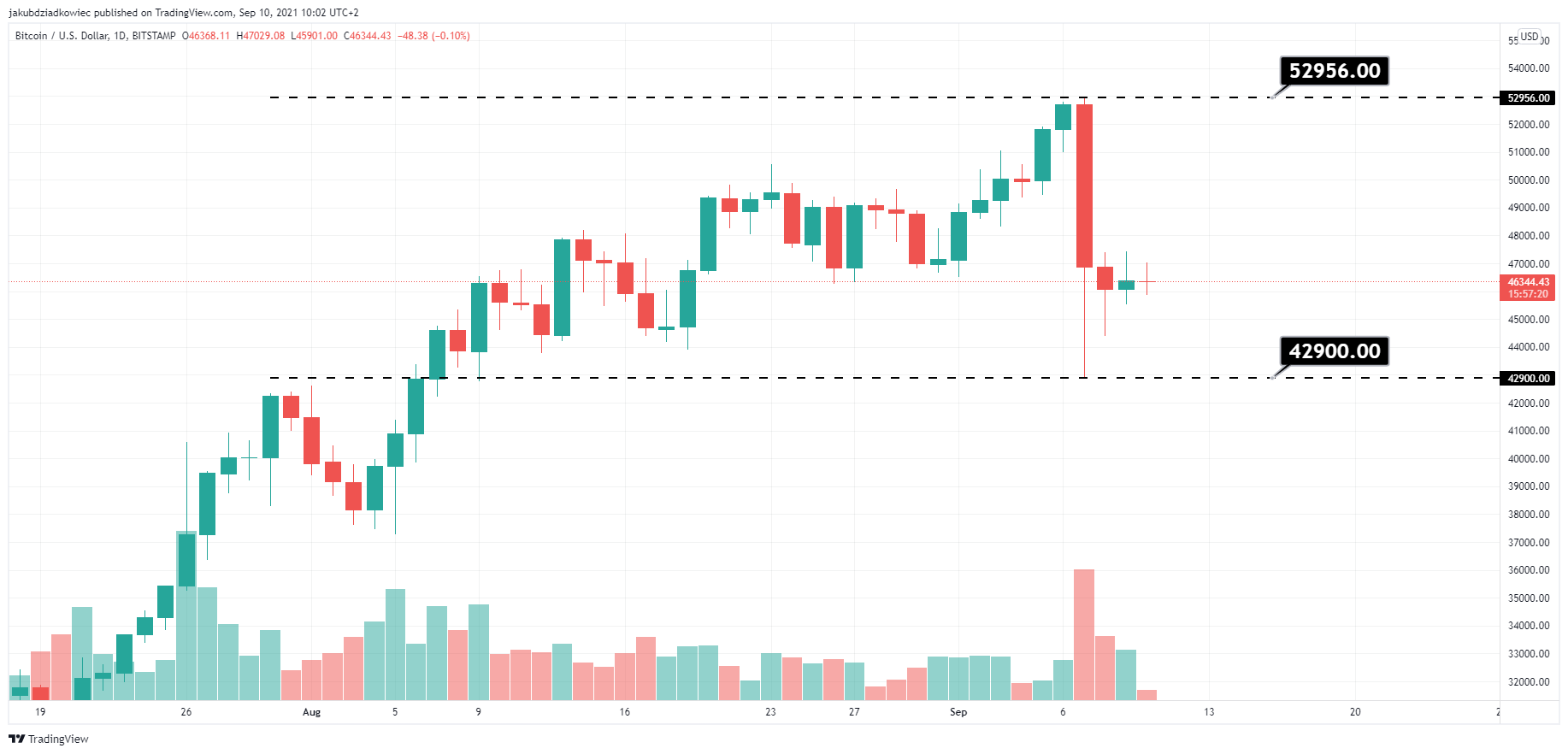
Last week, Bitcoin reached a local peak at $52,956 just above the 0.618 Fib retracement level on September 7. On the same day, there was a flash crash that took the BTC price to a low at $42,900. One of the reasons for the 19% decline was the clearing of long leveraged positions, which experienced liquidations totaling $4 billion.
Sponsored
Shortly after the sharp decline, the price rebounded and is currently trying to recover around $46,000. Despite the short-term rebound, technical indicators on higher intervals arestarting to give bearish readings.
However, it is worth noting that the decline has served to validate the long-term area at the 0.382 Fib retracement as support. This area coincides with horizontal support levels and Bitcoin’s historic all-time high of January 8, 2021.
Investors buy during the crash
On-chain analytics data can help explain how investors behaved during the sharp decline. It turns out that many investors holding actual BTC did not show significant movements during the flash crash.
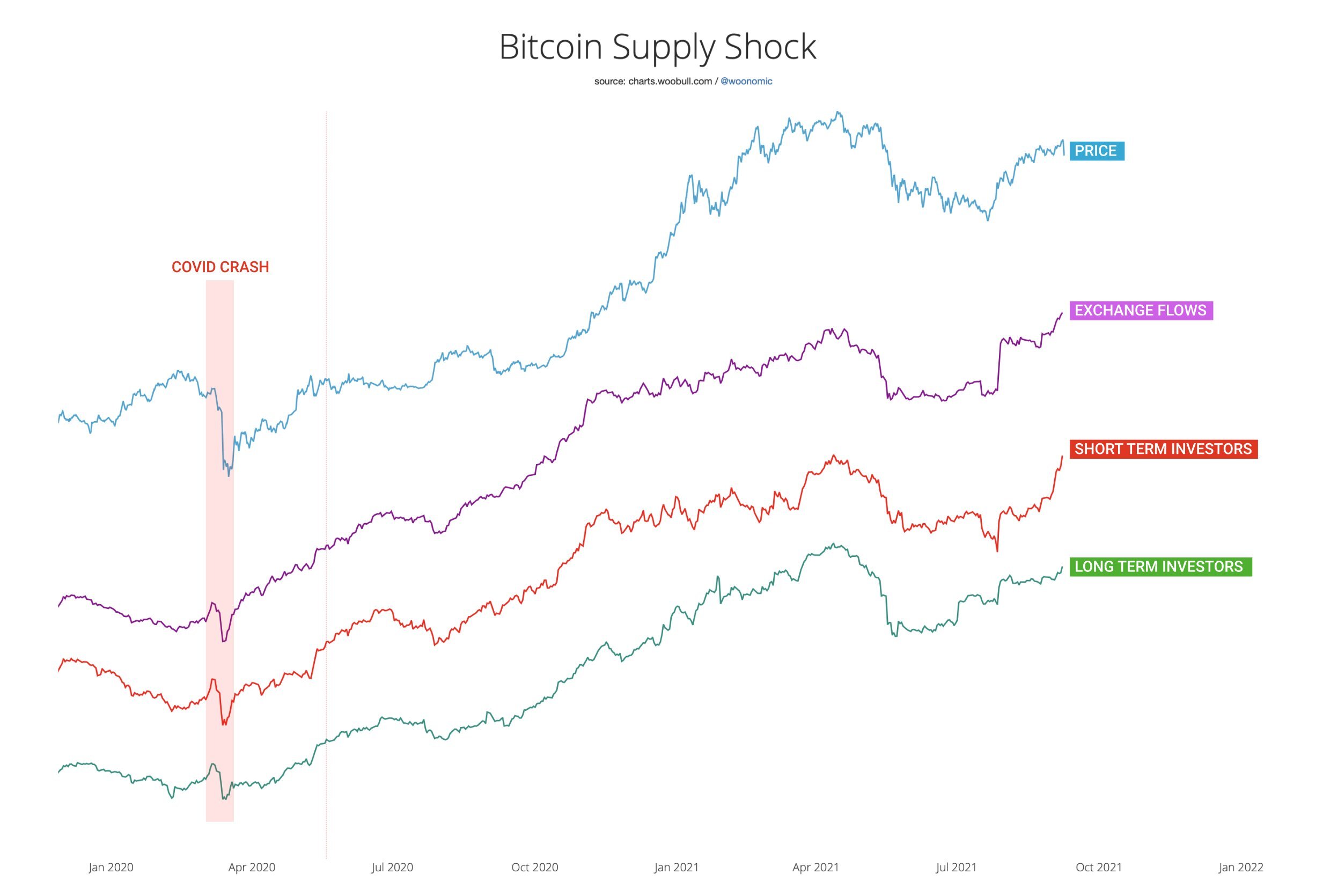
This was pointed out by on-chain analyst @, who said in a tweet that “leverage markets sold off but investor buying just got stronger”. Furthermore, he compared the recent fall to the crash caused by the COVID-19 crisis in March 2020. Woo stated:
“BTC flash crashes are caused by deleveraging, the COVID crash was similar in that derivatives overreacted, but back then it was supported by investors. This one was completely divergent and a mystery.”
This is supported by the on-chain analyst’s accompanying chart, which shows an intensifying supply shock on multiple levels: stock market outflows and short- and long-term investor positions. Woo concludes that the effect of the decline is merely “cheap coins”.
Source:
Bitcoin continues to drain from exchanges
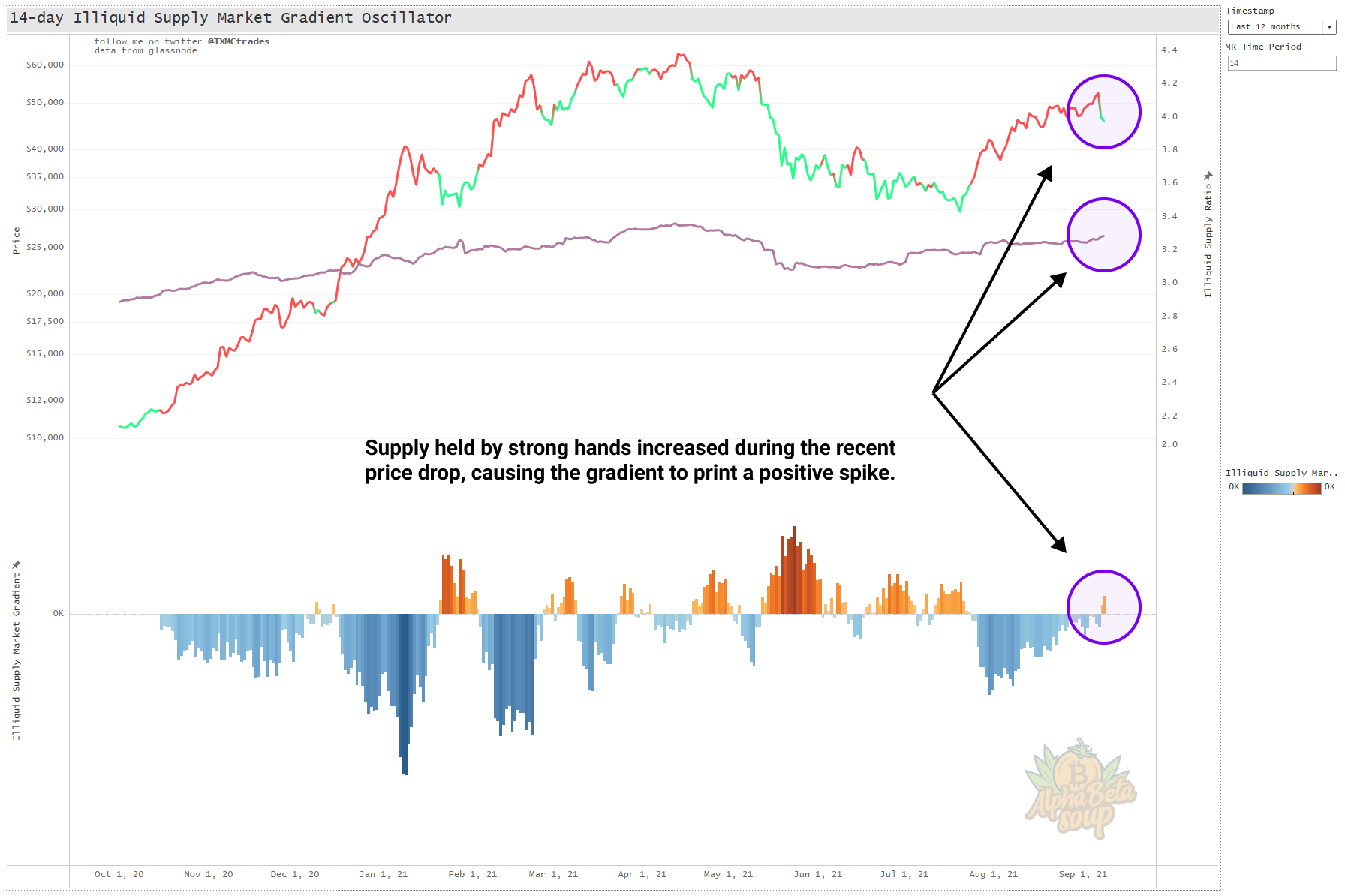
Willy Woo’s observations are confirmed by another on-chain analyst @, who points to the 14-day Illiquid Supply Market Gradient indicator. It is used to estimate when long-term investors with strong hands are holding their positions more tightly than the price action indicates.
According to the analyst, “long-term investors were unshaken by the drop and actually increased their holdings”. This is confirmed by the divergence between the increase in investor positions and the drop in the BTC price and by the two orange bars at the bottom of the chart below.
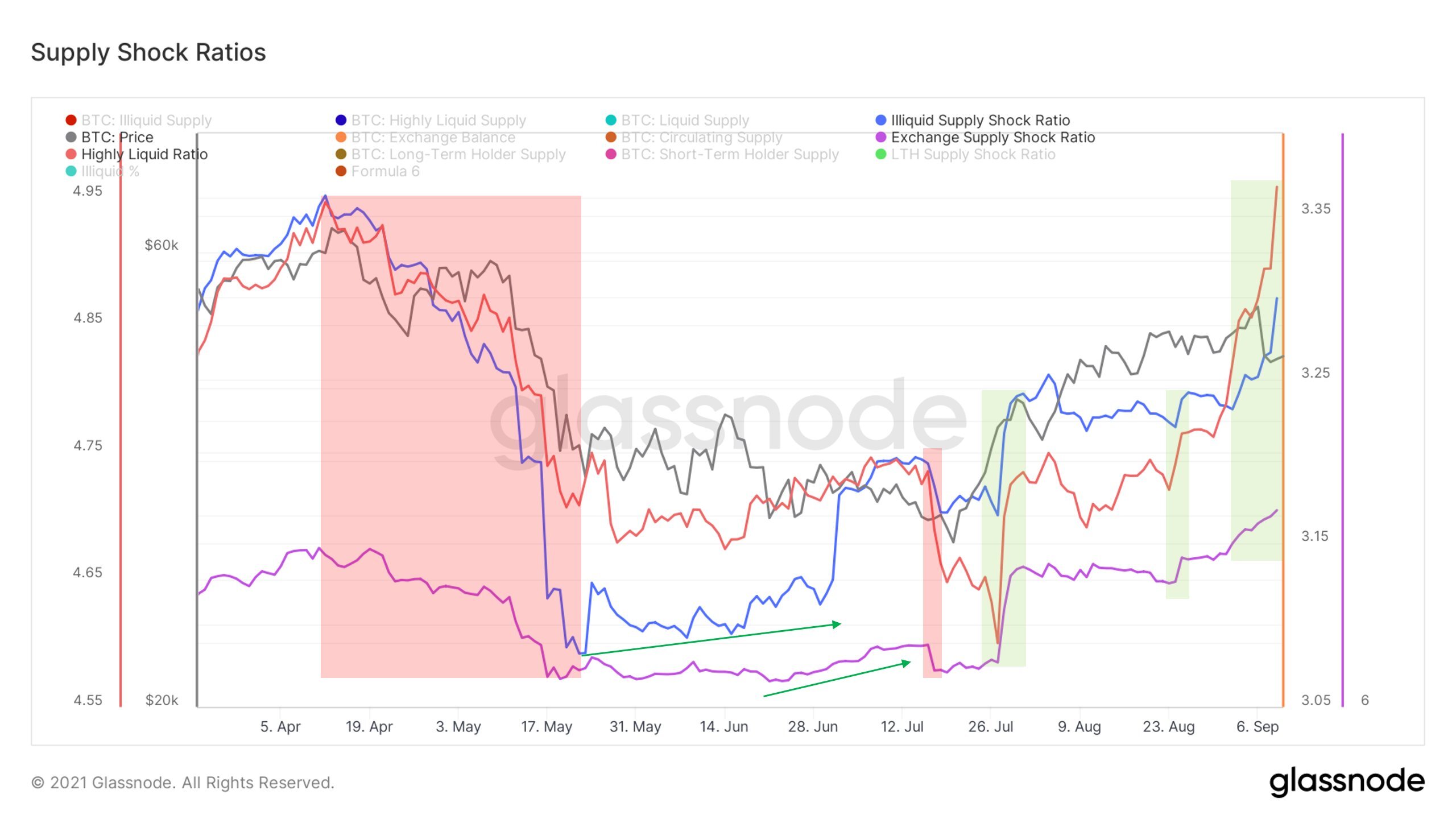
An additional argument was provided yesterday by@, who also pointed out the intensifying supply shock on Bitcoin. The on-chain analyst encourages people to “ignore the noise” and focus on the upward macro trend triggered by the diminishing number of available BTC coins.
Source:
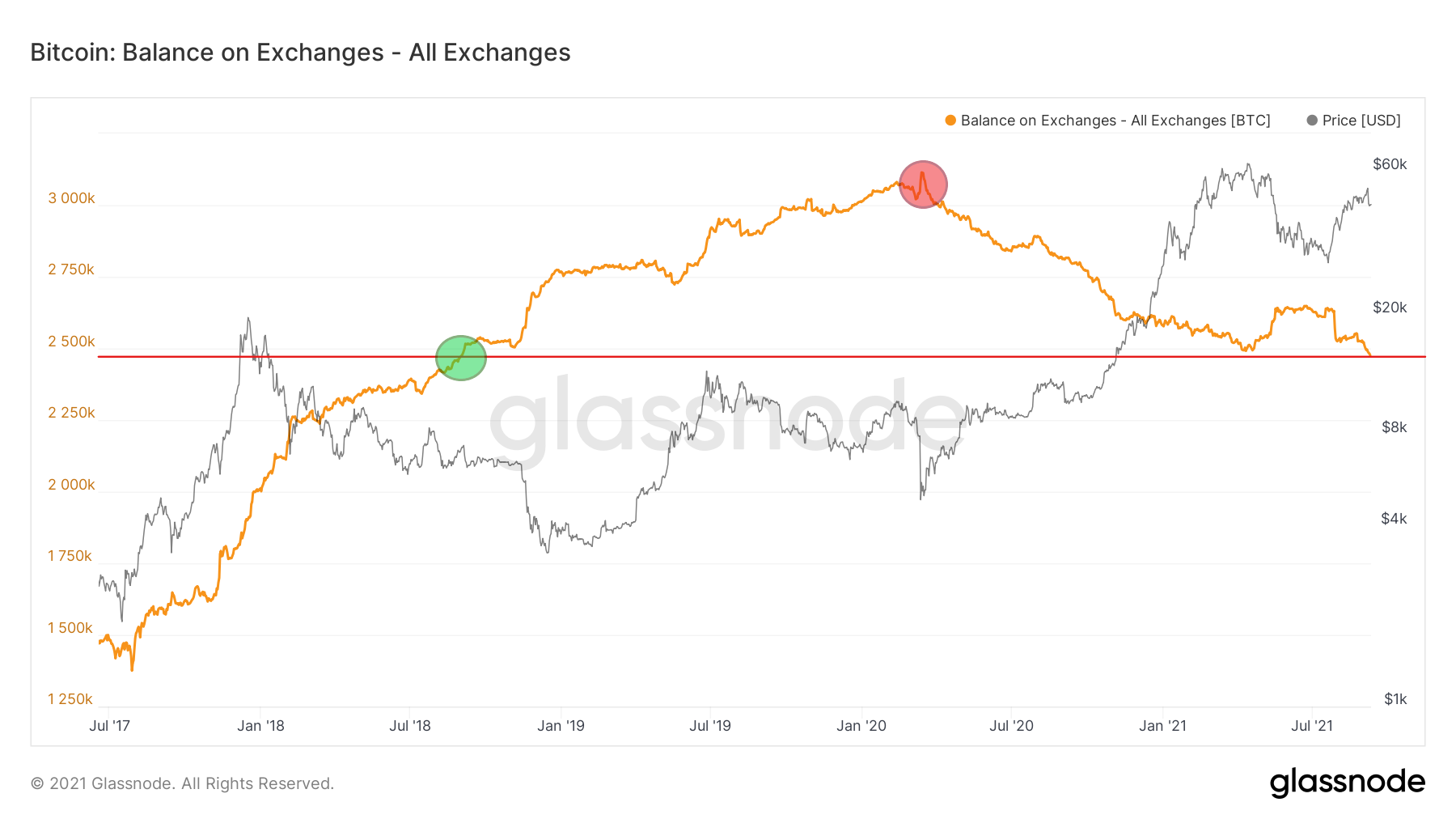
The long-term outlook highlighted by all three of the aforementioned analysts is very much evident in the chart of the balance of Bitcoin held on cryptocurrency exchanges. It turns out that the amount of BTC on exchanges has been steadily declining since the COVID-19 crisis (red circle).
The only two significant increases in coins on exchanges in this period were seen during the rises in the price of BTC in July 2020 and especially during the recent falls in May 2021. Furthermore, the amount of BTC available on exchanges has just reached a 3-year low. The last time exchanges recorded such low supply was in late August 2018 (green circle), with Bitcoin trading at around $7,000.
Small positions are growing
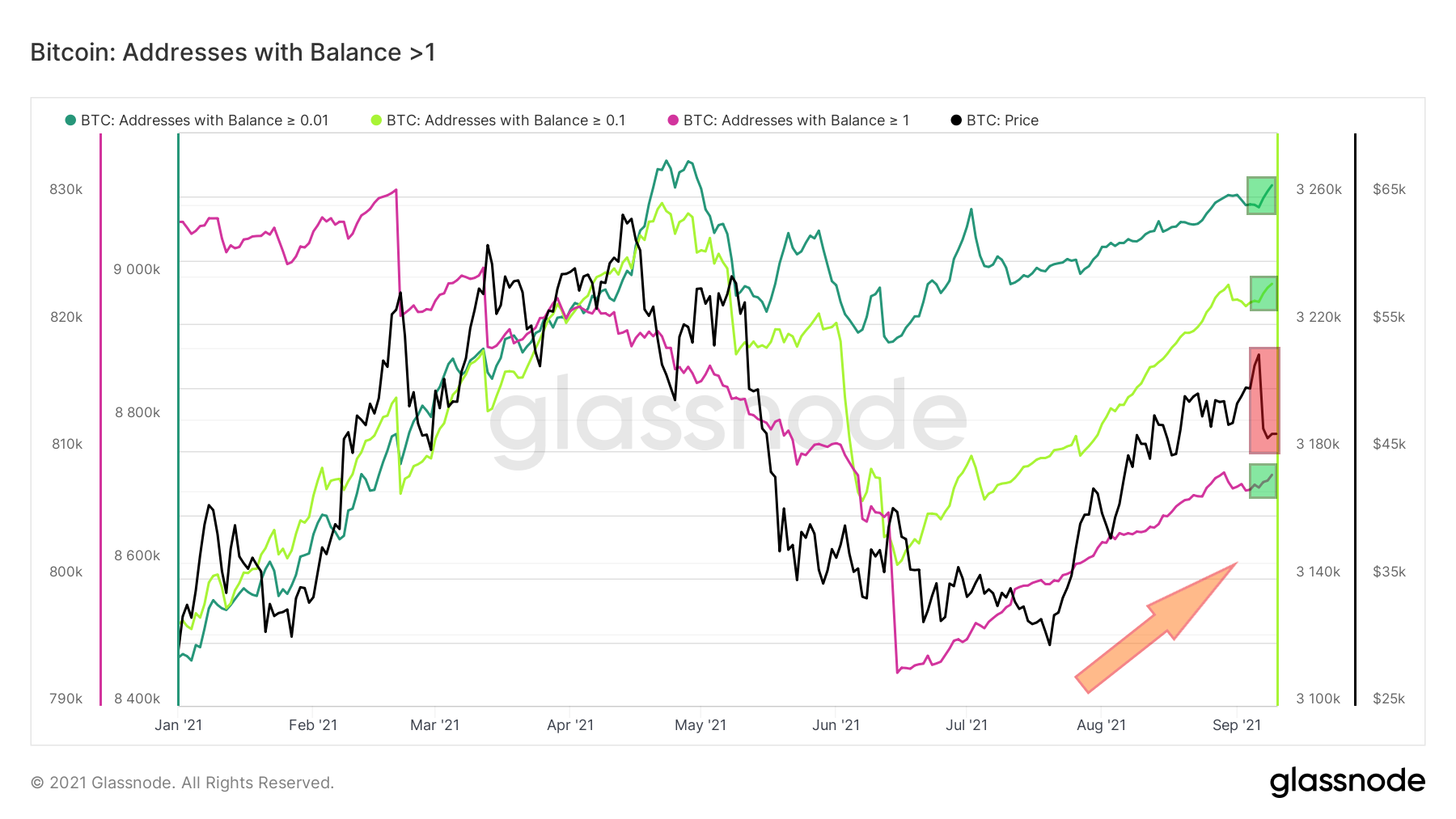
The last indicator worth noting in perspective of the recent decline is the number of addresses that hold different amounts of BTC. In the first group, there are 3 types of addresses with small amounts in the 0.01-1 BTC range.
Here we see a clear continuation of the upward movement (green rectangles) despite the drop in the Bitcoin price a few days ago (red rectangle). The number of small positions has been increasing since at least the middle of the May-July 2021 consolidation (orange arrow). The recent flash crash has only reinforced this trend.
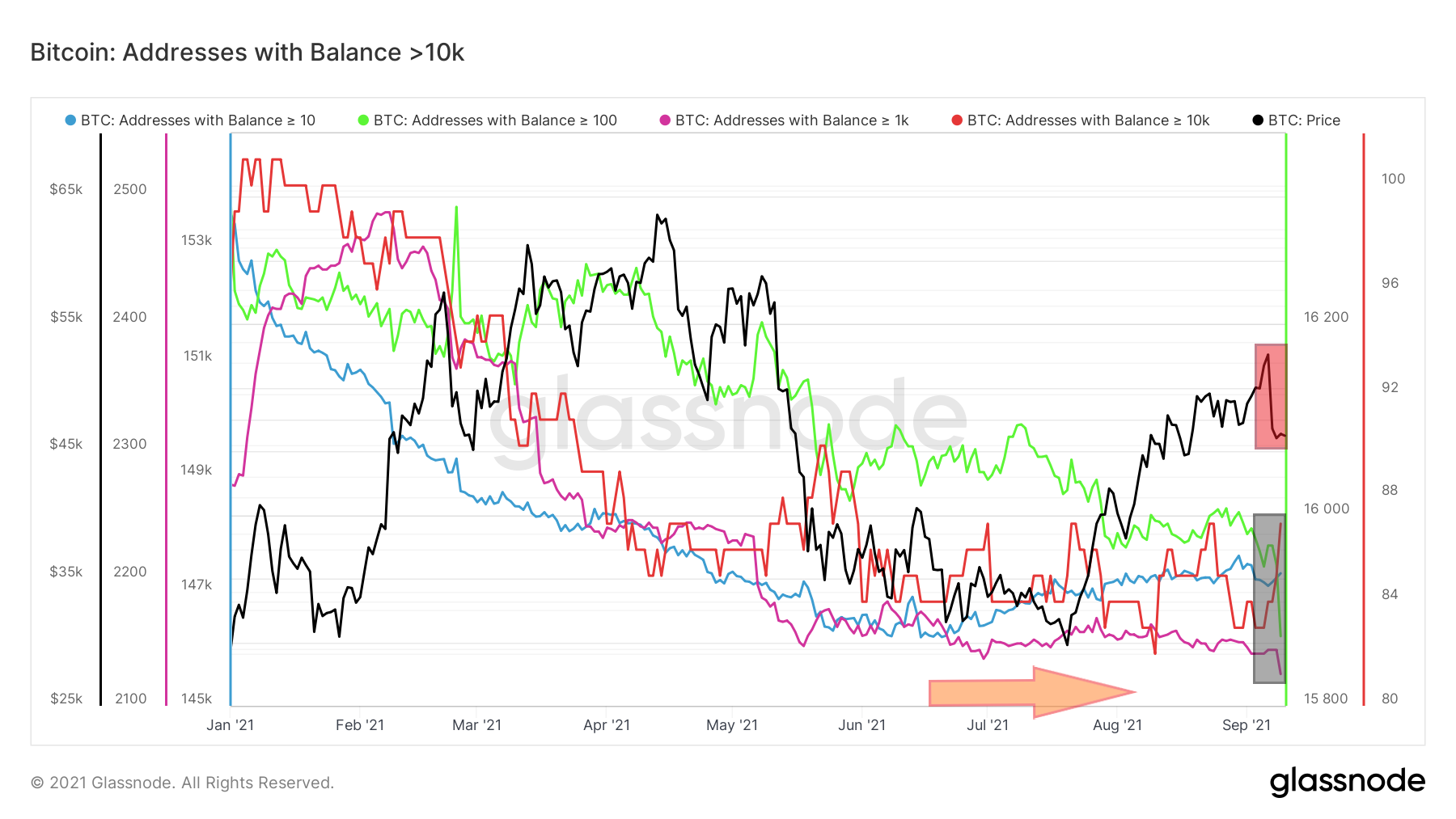
We see more diverse behaviour in the second group of addresses, which collects positions with amounts between 10 and 10,000 BTC (grey rectangle). Increases were seen in addresses with more than 10 BTC and more than 10,000 BTC. Declines are seen in addresses with more than 100 BTC and more than 1,000 BTC. Moreover, since the consolidation of May-July 2021, the trend in the number of large addresses remains horizontal (orange arrow).
Finally, it is worth noting that regardless of the amount of BTC held, the general trend in the number of addresses is not downward. This indicates the strong organic growth of the Bitcoin network and, through the continuous increase in the number of small addresses, the increasing distribution of coins.
Foreign investors will be exempt from tax on their bitcoin profits in El Salvador, according to a legal adviser for the government.
Speaking to AFP, Javier Argueta, legal adviser to President Nayib Bukele, said,
“If a person has assets in Bitcoin and makes high profits, there will be no tax. This (is done) obviously to encourage foreign investment.”
Argueta also said that the country was working with international agencies to implement compliance measures. Global bodies like the International Monetary Fund (IMF) have highlighted traceability and the prevention of illicit financial activities as key worries.
The ratifying of bitcoin as legal tender, though still in its early days, is proving to be somewhat problematic for the country. There has been criticism from all sides, from the opposition party to global bodies across the world. But the government has not trudged on, undeterred by this resistance.
The Chivo Wallet, which is El Salvador’s official bitcoin wallet, was launched on Sept 7, with $30 in BTC offered for first-time users. The government bought 400 bitcoins to prepare for the change, which has to be said isn’t going perfectly.
It remains to be seen how the change will proceed in the medium and long term. Critics have listed a number of issues, with volatility being the number one concern. The country’s internal ministers have drawn attention to this, saying that salary payments could be affected by the volatility.
El Salvador bitcoin adoption filled with ups and downs
The general consensus is that the El Salvador decision is one that has been a rollercoaster ride for the country. This is a first-of-a-kind move for bitcoin, and many are curious to see how it will play out on such a large scale. The upcoming 12 months will be instrumental in seeing how bitcoin plays a role in the local economy.
Those inside the cryptocurrency world have offered their own take on the matter. Charles Hoskinson, CEO of Input Output Hong Kong (IOHK), said that every country needs a bitcoin strategy. He praised El Salvador’s decision, and went so far as to say that there is “nothing in human history that has grown that quickly.”
But of more concern is the fact that citizens are taking to the streets to protest the move. The wallet appears to be working as intended, though there have been some hiccups with ATMs. One citizen group has also filed a lawsuit against the government, which is the most severe move yet.
El Salvador now has over 200 Bitcoin ATMs installed, which should help boost its attempt to make bitcoin a greater part of the economy.
Sponsored
Data from Coin ATM Radar shows that El Salvador has the third-highest number of bitcoin ATMs across the world, behind the United States and Canada. In total, El Salvador’s bitcoin ATMs account for 0.7% of all such machines worldwide. The U.S. and Canada lead with 86.4% and 6.6%, respectively.
El Salvador has had to beef up its infrastructure following the announcement that it would make bitcoin legal tender. The country has also purchased 400 bitcoins to facilitate the move into digital assets. Additionally, it has built and released a digital wallet called Chivo to make transactions more seamless.
Sponsored
despite these changes to the system, the transition is far from smooth. There have been reports of ATMs being destroyed ascitizens protestagainst the government for various reasons.
One of the primary issues that both opposition party members and citizens have with bitcoin is the volatility associated with the asset. For example, some in the country have drawn attention to salary payments, which could be gravely affected by it. Bukele has insisted that bitcoin use will be optional, which has somewhat appeased critics.
It does not help that these groups have several other issues with President Nayib Bukele’s government. At this point, it’s unclear how this move, the first of its kind, will affect the country both internally and externally. Other nations will keep a close eye to see the ramifications, even if they were never keen on legalizing bitcoin.
El Salvador’s bitcoin experiment highly divisive
To say that El Salvador’s decision to legalize bitcoin is controversial is a severe understatement. While market enthusiasts have cheered the move, there has been little to celebrate following the passing of the related legislation. Most recently, an El Salvadorian court began investigating the government’s purchase of bitcoins.
Condemnation arrived swift and strongly from many sides, including from international bodies regulating financial matters. The International Monetary Fund issued a statement saying that there would be macroeconomic and legal issues related to the move. The World Bank has outright said that it would deny assistance to the country, adding to its woes.
But that has not stopped the government from resolutely following through with its plans, and Bukele hopes to attract entrepreneurs and investors. He has declared that foreigners would be exempt from capital gains tax on their bitcoin profits, besides granting permanent residency.
It has only been a few months since the law was passed and even fewer since the infrastructure like the Chivo wallet appeared. Any long-term effects of making bitcoin legal tender will only be apparent over the next year or two.
It’s already 2021, historically the first year in this crypto cycle, almost entirely bullish in nature. I have taken a deeper look at the industry and have prepared a list of the top ten aspiring coins for 2021.
Sponsored
Which projects have the best chance of success? Can the parabolic rises of 2020 continue? Where is the best place to invest smartly and reduce the chance of failure while increasing your profit potential? Which crypto projects will rise to the top in 2021? Let’s dive in!
The Methodology Behind the Top 10 Ranking
When selecting projects for the top ten aspiring cryptocurrencies for 2021, I used three criteria. While any such rankings are arbitrary, I am giving the reader an opportunity to evaluate the list for themselves by disclosing my methodology.
SponsSponsored
The three criteria are as follows:
Position in the CoinMarketCap ranking
My set includes established projects from the list of the top 30 cryptocurrencies, according to CoinMarketCap, with a good reputation and a transparent trading history.
The purpose of the analysis was not to search thousands of cryptocurrencies to identify risky gems that could moon 100x, 1000x, or even 10,000x next year.
They could also drop to zero. I prefer to identify some of the most reliable projects with the best risk-reward ratio.
Source:
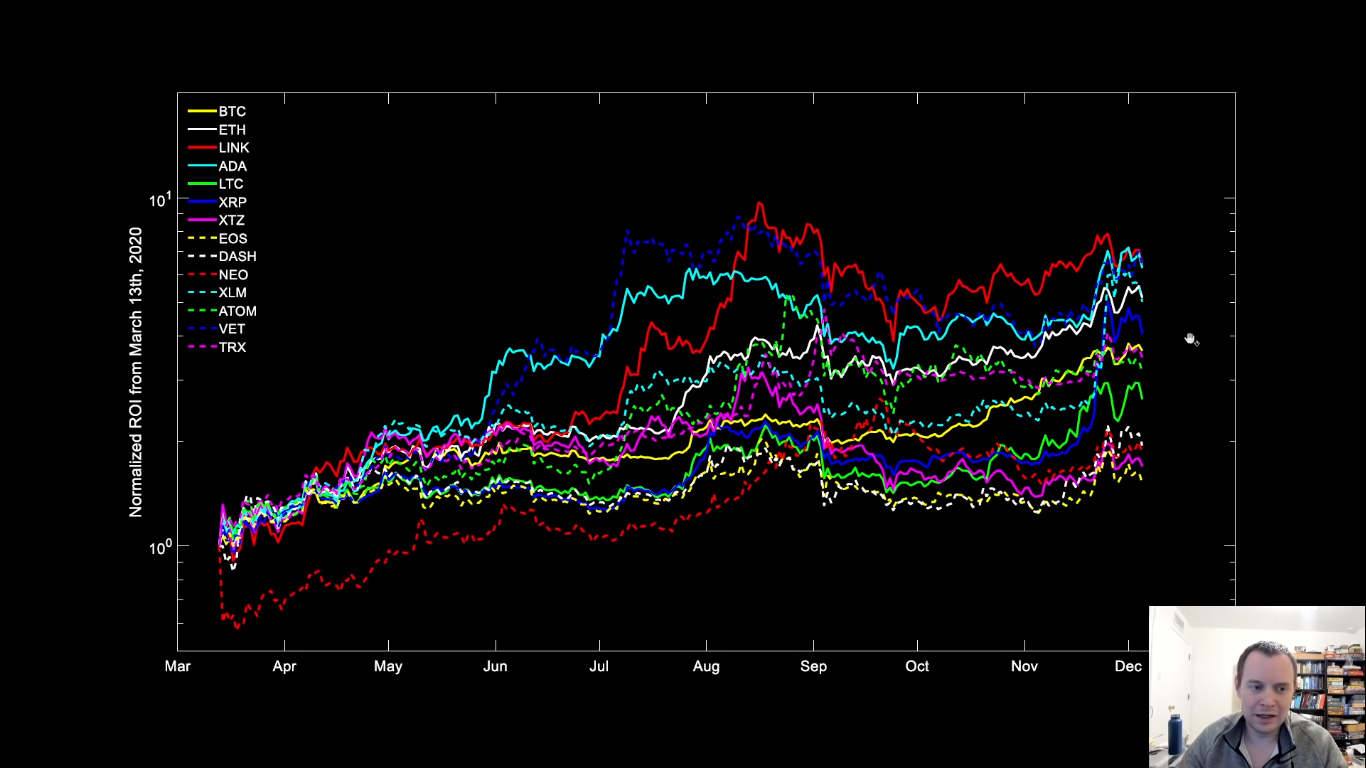
Annual ROI chart
The chart contains historical data on selected cryptocurrencies and compares the return on investment (ROI) that investors could have gained during 2020.
One commentator who refers to this chart frequently is Benjamin Cowen. In the video below, he indicates cryptocurrencies with the highest ROI from March to December 2020. LINK, VET, and ADA were the top three, followed by XLM and ETH.
Source: YouTube
Opinions of crypto market experts
This is the most arbitrary criterion. There are influencers, commentators, and analysts of all kinds in the crypto sphere, but there’s certainly no consensus on who is unquestionably an authority.
Thus, we only refer to a few people, such as Cowen, Kevin Svenson, and Lark Davis.
Each coin’s description includes a brief outline of its specification and foundations, the latest news that suggests a strong entry in 2021, and a paragraph on long-term price action.
Before jumping in, note that a fantastic place to trade is on Stormgain! Click here to sign up.
The top ten aspiring cryptocurrencies for 2021 begin with the orange king of crypto itself: Bitcoin (BTC).
Created in early 2009 by Satoshi Nakamoto, the first cryptocurrency is, in fact, a distributed, decentralized ledger where users send funds directly to each other, peer-to-peer, without an intermediary.
There is no need to convince anyone who has been around the cryptosphere for a while that investing in bitcoin is profitable. Especially recently, when on December 16, BTC broke out from $20,000, 2017’s historical all-time high (ATH).
So far, bitcoin is one of the most profitable assets in history, surpassing big names like Amazon, VISA, Microsoft, and JP Morgan in terms of ROI by several orders of magnitude
But some people ask, is it still profitable to buy bitcoin at such a high level above $20,000? Does anyone else still buy? This turns out to be an overwhelming yes! And it’s not random retail players who missed the discount prices during the March crisis (below $4,000), but serious financial institutions.
In the recent top 5 list of institutional investors, BeInCrypto showed that companies like MicroStrategy, 3iQ, or CoinShares are investing additional capital into BTC.
The Grayscale Fund is a leader in mediating between the purchases of the alpha cryptocurrency and its investors’ interests. The secret Bitcoin purchases made for some time by Guggenheim Partners and MassMutual have also recently come to light.
We are witnessing the first Bitcoin cycle in which institutions are initiating the rally. Something that Bitcoin hodlers have been expecting for years, and that could bring unprecedented gains in the crypto market.
Some investor’s decisions may result in an avalanche of followers who’ll want to FOMO in for themselves. For example, according to JP Morgan’s estimates, 1% of the capital in pension funds and insurance companies in Europe, Japan, and the USA would be enough to pump an additional $600 billion into the crypto market.
The involvement of big financial institutions and other macroeconomic factors could lead to an enormous BTC price explosion in 2021 and the fulfillment of optimistic forecasts.
Stellar (XLM) is a blockchain network for storing and transferring money. It was established in 2014 to increase financial integration in different regions of the world and help companies exchange value.
The network’s main task is to provide a platform for low-cost payment services where the transaction fee is fixed at only 0.00001 XLM.
Stellar has succeeded in integrating with several fintech companies. A few years ago, it launched World Wire together with IBM. The platform enables transactions between bridge assets like stablecoins.
What’s more, it incorporates the idea of decentralization. The Stellar network allows users to vote in the decision-making process when adding companies to the ecosystem.
Source:
XLM is gaining additional global adoption after Grayscale Investments created a dedicated trust.
As BeInCrypto recently explored, the oldest bank in Germany, Bankhaus von der Heydt, announced the creation of a euro stablecoin (EURB) on the Stellar blockchain. It’s the first token of this type issued by a banking institution.
XLM’s price action since the March crisis is impressive. The cryptocurrency is among the top five coins that have brought investors the highest ROI. From the low of $ 0.026 in March to the high of $0.23 in November, XLM generated almost 800% profit.
Currently, Stellar is undergoing a deeper yet healthy correction that recently reached the 0.5 Fib level of the entire long-term upward movement. The all-time high (ATH) from January 2018 at $0.94 is still quite far away, which gives great potential growth in 2021.
Tezos (XTZ) created its own blockchain network for smart contracts that aims to evolve. One of its tasks is to avoid Ethereum and Bitcoin errors, allowing hard forks. Adaptability, an open structure, and the influence of validators (bakers) on the network are its main advantages.
A recent upgrade to the Tezos network called Delphi planned to cut smart contract gas fee by 75% to attract DeFi developers to the ecosystem. However, Tezos’ applications extend much further and implement the latest trends in the crypto market, such as NFTs, video games, and the film industry.
Welcome to Delphi!
\\\\
Tezos recently announchttp://ed a partnership with Logical Pictures, a European film producer, with a $ 121 million project. This is one of the first initiatives towards tokenization of movies and series, thus investing in the movie industry using crypto.
This will likely set a new trend for investing in Hollywood movies and provide a greater ROI, fluidity, and transparency in the film industry.
Since the launch of the Tezos mainnet in 2018, XTZ’s value has been growing. The price of the token was steadily increasing until it reached an ATH of $ 4.48 in August this year.
Later, however, there was a deep correction, reaching the 0.786 Fib of the entire upward move from March 2020. Today, XTZ needs to double its price to return to the ATH.
However, both the sensational results from the first half of this year and the structural strength of the upward trend make Tezos an excellent investment option at the beginning of 2021.
If 2021 is to be the year of cryptocurrencies, trading platforms will be in the spotlight and should see great benefits. Cryptocurrency exchanges could be one of the biggest winners of the coming crypto madness.
Even though more cryptocurrency trading is moving towards decentralized exchanges, their well-managed centralized older sisters still dominate. And the biggest one is Binance.
Launched in China in July 2017, Binance has the unrivaled largest trading volume, offering access to hundreds of crypto assets. It was founded by the charismatic Changpeng Zhao (CZ), who has held the status of a cryptocurrency celebrity for years and is one of the most recognizable characters in the industry.
CZ was included in “The Bloomberg 50,” published in December. The list contains 50 people who have shaped the world’s financial, political, technological, and scientific landscapes in 2020.
Binance has had a huge impact on the crypto market for years. According to a statement by CZ, in 2020 Binance would generate profits between $800 million and $1 billion.
In 2019, profits reached $570 million. 2020 will likely double this record-breaking figure. Moreover, the exchange is also entering the DeFi market with the recent launch of its Binance Smart Chain. It claims can quickly and cheaply handle transactions of various asset classes.
Source: Binance
Binance’s upward prospects are not without impacting its native token, the Binance Coin (BNB), likely to be an excellent investment choice. BNB went live several days after the opening of the exchange in 2017.
In June 2019, the token reached a historical ATH of $39.57. It hit a low of $6.41 during the March crisis but has since been rising in price and recorded a new ATH of $40.17 on December 29.
An additional advantage of holding BNB is lower or zero commissions for trading on Binance and the possibility of using it to buy other tokens in periodic sale campaigns.
6. Uniswap (UNI)
Price: $3.63 Market Cap: $972 million Rank in CoinMarketCap Rank: 30
The Binance example shows how finance flows into cryptocurrency exchanges. And if we combine the growing potential of trading platforms with the biggest crypto hits of 2020, which undoubtedly became Decentralized Finance (DeFi), we get decentralized exchanges (DeX).
The leader in this niche is the Uniswap exchange with its UNI token. Although the spectacular boom in the DeFi market collapsed along with the drastic drops in early September, there are many indications that the growth in popularity of this industry will continue in 2021.
According to available data, the number of users in the DeFi space has increased over ten times in the past year: starting from less than 100,000 and ending with over 1 million.
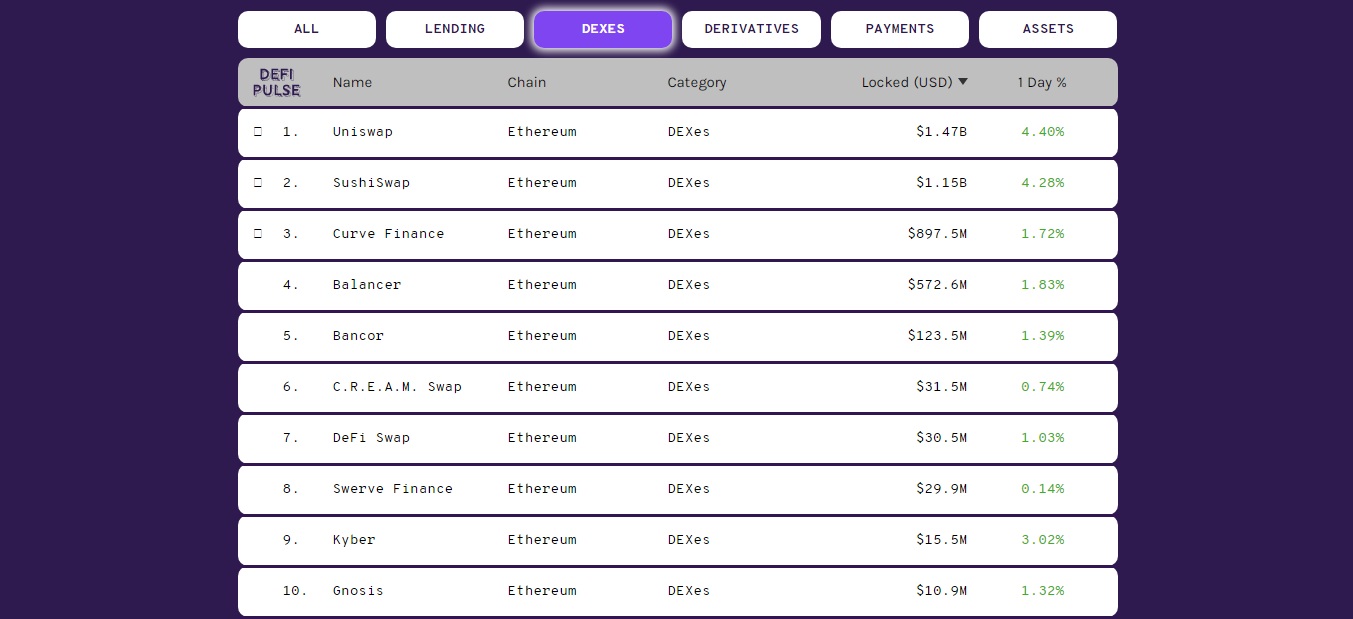
Uniswap is the leader of decentralized exchanges in many respects. The amount of total value locked (TVL) is worth $1.47 billion. Users have already created 600,000 addresses relating to DeFi.
In September, the exchange created and released its own UNI governance token. As in the case of Binance, this move adds new profit potential to Uniswap users and the possibility of a real impact on its future.
There are many indications that 2021 will be a breakthrough year for Ethereum, the second largest crypto project, and its cryptocurrency Ether (ETH).
Unlike Bitcoin, the Ethereum blockchain is a decentralized system that serves as a platform for many other cryptocurrencies and smart contract development.
Ethereum’s goal is to build a global network for decentralized applications (dApps) that would enable the writing and running of software that would be immune to fraud, delay, and censorship.
Ethereum’s prospects are great, as are the problems its developers have experienced over the years. Only this year, after many months of preparations, we finally saw the long-delayed launch of Ethereum 2.0 that initiates the transition to PoS (Proof-of-Stake) from PoW (Proof-of-Work).
On December 1, network validators began stacking ETH, and the price of the cryptocurrency broke $620.
Ethereum has a huge spectrum of potential applications. Suffice to say that virtually the entire DeFi world is built on the Ethereum blockchain. And this world is opening up to additional investors.
Many institutional entities have already gained exposure to Ethereum through the Grayscale Fund (ETHE). As BeInCrypto recently explained, this was followed by 3iQ from Canada, which is preparing to launch an ETH fund for its customers.
Moreover, the latest report shows that the CME Group, the largest exchange for financial derivative instruments globally, is preparing to launch futures contracts for ETH.
Therefore, it seems that institutional investor interest in 2021 will not be limited only to Bitcoin but also redirected to Ethereum.
This may be because Ether, unlike Bitcoin, is still far from breaking its January 2018 ATH at $1,432. ETH still needs around 100% growth to achieve this, so the profit potential seems to be much greater here.
Polkadot (DOT) is an open-source protocol for sharding that enables the transfer of data and tokens between different blockchains. It is characterized by interoperability, which aims to create a fully decentralized and private network to develop applications and services.
Its native DOT token serves three purposes: network governance, operations, and the creation of parachains (parallel chains) through bonding.
A recent listing on most major cryptocurrency exchanges pushed the DOT price to an ATH of $6.84 in early September. Despite the correction, the cryptocurrency price has stabilized and is growing faster, laying the foundation for positive price action in 2021.
Polkadot is on the right track to permanently join a group of the most important cryptocurrency projects. One of YouTube’s crypto-influencers, Lark Daviscompares the impactthat Polkadot may have on the cryptocurrency market in the current cycle to that of Ethereum in 2017.
In his opinion, this young project’s growing ecosystem is already crushing the lists of partners the competition can boast.
Recently, the project’s founder Gavin Wood, who is also one of the creators of Ethereum, stated that Polkadot should not be seen as an “Ethereum killer” but rather as a blockchain maximalist killer.
The idea behind Polkadot is not to favor a selected blockchain but to build a “network for the networks” in which bridges and connectivity will be most important aspect. Speaking to Laura Shin on the Unchained Podcast, Wood added:
“If Ethereum ends up being a chain that is sort of bridgeable […], I think that there’s a very good chance that Polkadot and Ethereum will happily coexist.”
The vision outlined by the Cardano (ADA) creators is breathtaking. The team’s goal, led by the eccentric visionary Charles Hoskinson, is to provide a tool for creators, innovators, and visionaries to bring about positive, global change.
They are to rely on the redistribution of power from centralized, unaccountable structures into the hands of individuals who will create a safe, transparent, and just society. A truly impressive prospect!
Cardano has a very elegant but complex development roadmap. It breaks down the entire history of network testing, launching, and adoption into five development eras: the Byron (foundation), Shelley (decentralization), Goguen (smart contracts), Basho (scaling) and Voltaire (governance).
Source: Cardano
The native token ADA has a three-year history, beginning with parabolic growth at the end of the 2017 bubble that finished with an ATH of $1.33.
The drastic declines that followed stabilized the ADA price below $0.10, where it had been trading for more than two years. The coin recently managed to regain support at $0.10 and move more confidently towards new annual highs.
The results of the ADA price action in 2020 gives it a solid third place, after LINK and VET, in the high-cap ranking projects, which gave investors the highest ROI.
For example, blockchain enthusiast @recently emphasized in a tweet that ADA could soon outperform LINK in this respect. This is an excellent prognosis for 2021.
Cardano may be the project that will bring exceptional results in the coming year, not only in terms of technology but also in investment.
Supply chain management is a niche of blockchain technology for VeChain (VET). It aims to use decentralized management and the Internet of Things (IoT) to create an ecosystem overseeing various supply chains.
The idea behind VeChain is to increase the efficiency and transparency of shipping procedures while reducing costs and giving individual users greater control.
VeChain brings true innovation to an industry that has remained fairly stable over the years. Companies that want to increase transparency, control, and efficiency are looking to introduce blockchain technology to their businesses.
For example, recently VeChain announced a partnership with KnowSeaFood – a US company specializing in seafood gastronomy, an industry worth $100 billion.
Farmers will be able to communicate directly with consumers, who can pinpoint the exact origin of the seafood they buy.
The VET price action from the low in March to the ATH in August at $0.023 is impressive. The cryptocurrency saw a 1,478% profit, followed by an approximate 63% correction. VET is already making up for most of the losses and creating solid support before further upward movement.
Benjamin Cowen points out that an investment in VET from March to December 2020 gave a record-breaking ROI that only gave way to the LINK token.
If such price dynamics are maintained, there’s a good chance that in 2021 VET will break its ATH and experience parabolic increases again.
2020 was a breakthrough year for Chainlink (LINK). The cryptocurrency has firmly established itself in the first place in the segment of oracle providers and has hit the top 10 cryptocurrencies.
The robust development of the ecosystem (already over 350 partnerships) and the increasing adoption in various global economy areas are just some of the fundamental reasons making Chainlink an increasingly accelerating enterprise.
The explosion of the LINK price from the resistance at $5 in early July pushed it up to an ATH in the $20 area in just a few weeks. The subsequent correction reached -65% but did not frighten any of LINK Marines, and the project is systematically gaining in value again.
There is a growing number of LINK hodlers, who increased their ranks by 59% between August and December 2020, currently sitting around 285,361.
The co-founder and a major character of the project, Sergey Nazarov, took second place in the recent “DeFi Person of the Year” award. Nazarov is a mysterious influencer in the crypto world.
Only Andre Cronje from Yearn Finance defeated him. This emphasizes that Chainlink is becoming a standard solution in data handling by the oracle.
In the list of cryptocurrencies with the highest ROI from March to December 2020, prepared by Benjamin Cowen, Chainlink came first.
This is also confirmed by Kevin Svenson, who points out that LINK’s 2020 price increased from $1.50 to $20, making it one of the most profitable projects in the top 20 cryptocurrencies.
If this trend continues, we can expect LINK to be one of the dominant cryptocurrencies in 2021.
#Chainlink went from $1.50 -> $20.00 in the Year 2020 … absolute face melter. Top performing asset in the top 20 cryptocurrencies.
This is likely to continue. $LINK will likely melt faces once again in this next bull cycle seeing prices $ in the hundereds.
Conclusion: Top 10 cryptocurrencies
The above list of top ten aspiring crypto coins for 2021 was my choice, based on the criteria presented in the introduction. The cryptocurrency space still has many promising projects that have shown just a sample of their huge potential in the past few months.
It’s enough to mention here, for example, a few of the largest ones, such as Litecoin, Aave, Kusama, Zilliqa, or Theta. However, they weren’t included in my top ten list because the competition is huge, and the list is concise.
Remember, however, that out of over 8,000 cryptocurrencies that are registered on CoinMarketCap, the vast majority will fail and deprive hodlers of capital invested in them.
Therefore, your investment choices in this wild west of crypto should be made carefully, individually, according to your own expectations, preferences, and risk tolerance.
Either way, 2021 will be a unique and interesting experience for the cryptocurrency market.
Disclaimer: Cryptocurrency trading carries a high level of risk and may not be suitable for all investors. The views expressed here are those of the author and do not necessarily represent or reflect the views of BeInCrypto.
XRP, a cryptocurrency that is commonly touted as reaching an all-time highest value of around $3.80, was briefly worth thousands of times more due to one individual’s serious mistake.
Sponsored
Back in October, one unfortunate individual paid the equivalent of $8,341 per XRP — which is approximately 31,000 times higher than the then going market rate — ouch! Then again, at least one lucky individual managed to sell their XRP at massively higher than the market rate, all because they dared to set their sell order at a ridiculously high value.
Although it is not clear exactly how much XRP was purchased at this rate, it was enough to buy through the order books at the 1-minute timescale and produce a huge green candle.
Sponsored
The (Almost) Rise of XRP
To put this into perspective, had XRP continued trading at this value, this would have placed its market capitalization at around $361 trillion — or more than ten times more than the top 100 largest corporations in the world combined.
As it stands, it is unclear whether the sudden spike is the result of an order book glitch, or whether some poor soul actually managed to purchase XRP at this rate accidentally. However, this isn’t the first time somebody seemingly paid over-the-odds for a low-value cryptocurrency.
For example, when Zcash (ZEC) launched back in 2016, it initially opened on exchange platforms at 20,000 BTC — at the time worth approximately $1.37 million, whereas ZEC then crashed down to around $5,841 the day after it launched. Likewise, one unfortunate individual reportedly paid 1 BTC for 5 LTC on the now-defunct QuadrigaCX exchange in late 2017, when BTC was worth nearly $20,000.
An Accidental Entry?
Exactly why these orders occur remains a mystery, but there are two commonly spouted theories. The first of these is that the buyer accidentally entered the price of Bitcoin in the value field since it was trading at roughly around this price last October. However, since Coinbase features a warning prompt whenever you enter a suspiciously high price, it would need to be a severe case of negligence for this to be the explanation.
The second possible explanation is far more sinister and involves intentionally manipulating low liquidity trading pairs to extract gains from a compromised account. Since most platforms prevent withdrawals from compromised accounts, hackers can essentially transfer funds to another account with minimal losses by opening high-value trades on low liquidity trade pairs.
With that in mind, it might not be the worst idea to post some exorbitant sell orders up, with the hopes of being on the winning end of the next mistake.
The fundamentals supporting bullish price action on Ethereum (ETH) are everywhere. Is it time for ETH to break out for good this time?
SponsoreSeveral indicators point to another breakout rally in the second-largest cryptocurrency by market capitalization. Will institutional investors join their retail counterparts and smash through the $1,500 mark?
New Record Price in Sight
The monthly ETH price may be off to a good start after closing its previous monthly candle above the $1,300 price level. Ethereum’s market cap has recorded a 98% increase since the beginning of the year. At the time of writing, ETH traded just shy of $1,500.
The current price levels have served as strong resistance and were last seen during the 2017 ICO mania. After consolidating at the $1,300 price zone over the last few days, morevolatilitycould be imminent.
ETH On-Chain Indicators Bullish
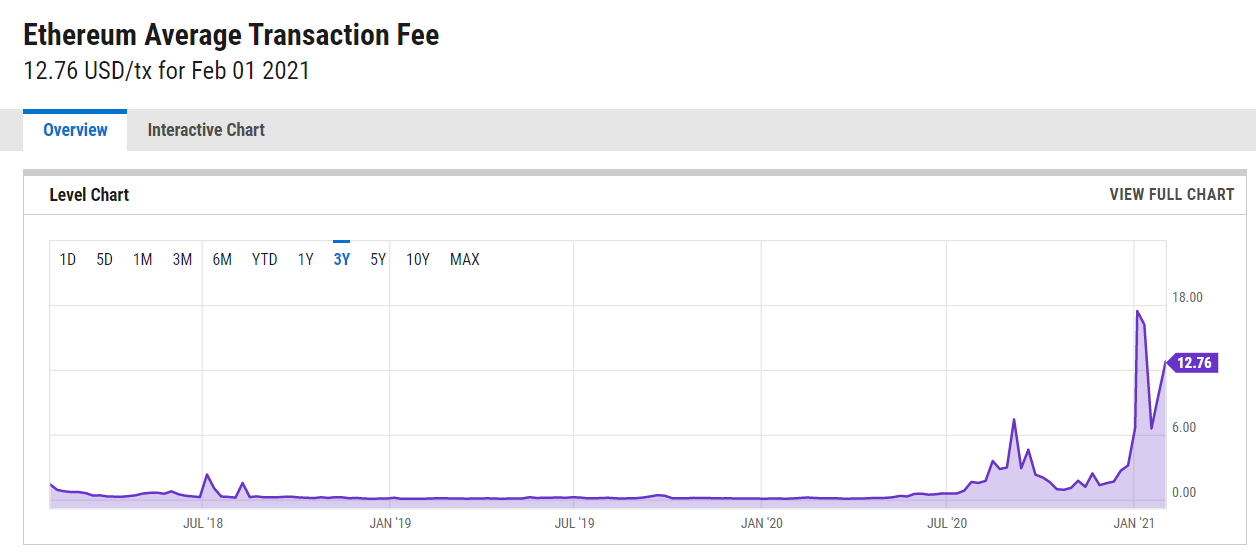
According to statistics from data analytics platform YCHARTS, the average Ethereum transaction fee is quickly heading towards its previous peak. At press time, this figure stood at $12.76, less than its previous January peak of $17.43.
The average transaction fee is the mean value market participants are willing to pay to interact with the network. The high fees suggest massive demand. Even the Grayscale Ethereum Trust recentlyreopened to investors and traders.
It’s pertinent to point out the difference between these levels with those of the last bull cycle. Activity on the Ethereum network has exploded in the last 30 months.
On July 5, 2018, the average transaction fee was just $2.03. This figure represents about 18% of the present cost. The rise of the Decentralized Finance (DeFi) ecosystem may have contributed significantly to this spike.
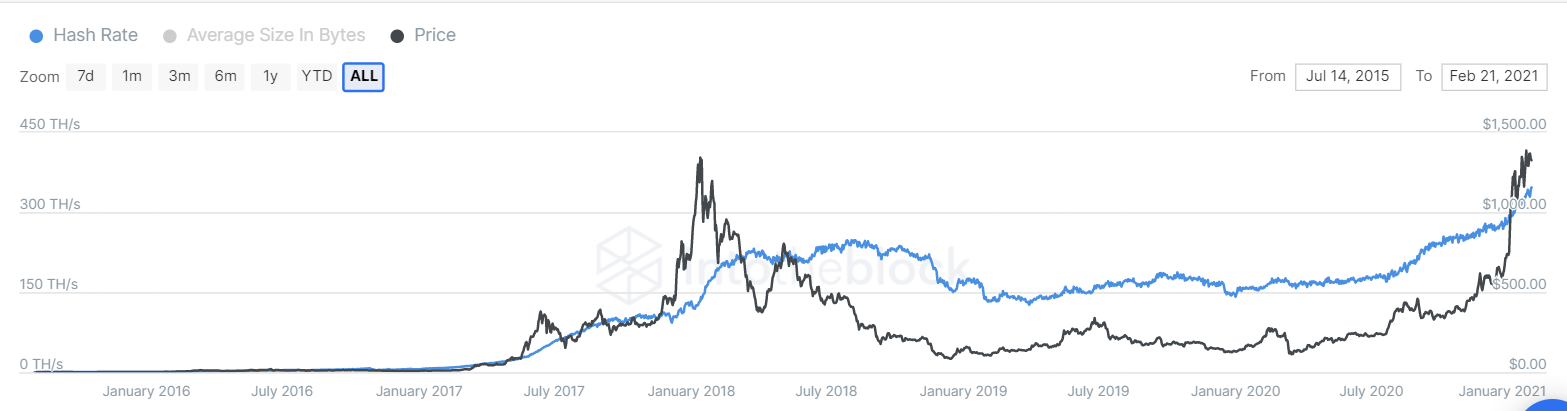
Similarly, Ethereum’s hash rate is surging steadily towards new highs. This metric measures the speed at which mining machines solve mathematical puzzles and validate blocks on the network.
An increase in value reflects more computational power being put to work in processing transactions.
Ethereum Hash Rate:
Historical records show that a new high in the ETH price has always accompanied a rise in hash rate. This suggests that Ether may still have a lot of room for growth at its current price.
The high number of addresses in profit also supports the bullish thesis, according to data from Glassnode. The number of holders in profit has reached a new all-time high of over 52,000 addresses. This figure is likely to rise in tandem with the price.
Much of the conversation around predicting the price of Bitcoin through 2020 and beyond hinges on the effect of the Bitcoin mining reward halving set to take place in May will have. Some believe it will have no effect at all, while others are betting big on this. If history is to be taken into consideration, Bitcoin should reach a new high of $400,000 following the event.
Sponsore
Following the first halving in November 2012, Bitcoin’s price increased from a $2.01 bottom to the top of $270.94 – a 13,000 percent increase. The second halving, in July of 2016, saw Bitcoin go from a bottom of $164.01 a top of $20,074 – a similar increase of 12,000 percent.
With this in mind, if Bitcoin moves similarly after May’s halving, investors can expect the price of the coin to reach as high as $400,000.
What’s Happened Before?
Bitcoin’s growth percentages after its first and second halving were so similar that the argument its third halving will follow suit appears to have some ground. But, a closer look at the similarities in the technical analysis of the price following the two previous events adds even more weight.
As explained in a Medium post by Rekt Capital, following the peak that came as a result of the first halving, Bitcoin entered into the 2013 bear market where the coin shed 80 percent of its value. It was a significant drop, and a rather rapid one, as the bear market lasted 87 days.
Similarly, after the price top that preceded the second halving, Bitcoin again shed more than 80 percent gains, but this bear market was far more intense as it lasted just a week short of one year.
Of course, there could just be a lot of coincidence between the previous two halvings that are being shoe-horned into the narrative that Bitcoin’s third halving will be anything similar. There are some rather significant differences, especially in timing. The length of the preceding bear markets is one, but it also took 513 days for Bitcoin to rally to its top after the first halving, and 1068 days – more than double – after the second.
Will the Third Bitcoin Halving Follow the Trend?
Yet, even with the halving still around five months away, we can again draw some similarities and parallels to the past.
Bitcoin’s bottom, following its rally to $20,000, was called in mid-December at $3,152. That means the bottom was reached 519 days before Bitcoin’s next halving – remarkably similar to the second, which bottomed at 544 days.
More so, the current price increase since the bottom is 340 percent at the time of writing, and for the second halving, Bitcoin gained 383 percent to reach its pre-halving top.
These trends are encouraging and play into the narrative that Bitcoin should rally to a certain level based on a 50 percent cut in incoming circulation. However, the asset is one that is yet to be truly figured out by analysts and could
Along with the rest of the equity markets, theBitcoinprice has been hit hard as COVID-19 has wreaked havoc on markets around the globe. However, when looking at the Bitcoin performance relative to other assets,some bullish patterns are starting to take place.
One such event is ‘decoupling.’ The Bitcoin price has begun to move in a different direction than the S&P 500, which has gone straight down over the past month. This suggests that Bitcoin could enter a prolonged accumulation phase, but has already reached a bottom. While there will most likely be less capital for investing in high-risk assets such as Bitcoin, institutional investments are still possible, especially with the possibility of traditional markets closing. This would most likely aid in its recovery. Furthermore, the third halving occurred in the end of May. Traditionally, the BTC price has gradually increased prior to halving and has accelerated its rate of increase afterward. This event takes on increased importance due to the ongoing massive fiscal stimulus by central banks throughout the globe. This should have a bullish effect on assets with a limited supply such as Bitcoin since fiat currencies are being devalued even more. It remains to be seen if Bitcoin will ever be the cryptocurrency that everyone ends up using. But, its likelihood of sticking around for the long-term is higher this year than it ever has been. In light of this development, BeInCrypto is going to make an attempt to predict the Bitcoin price at the end of the year, on December 31, 2020, 2021, and 2025.
Short-Term Prediction
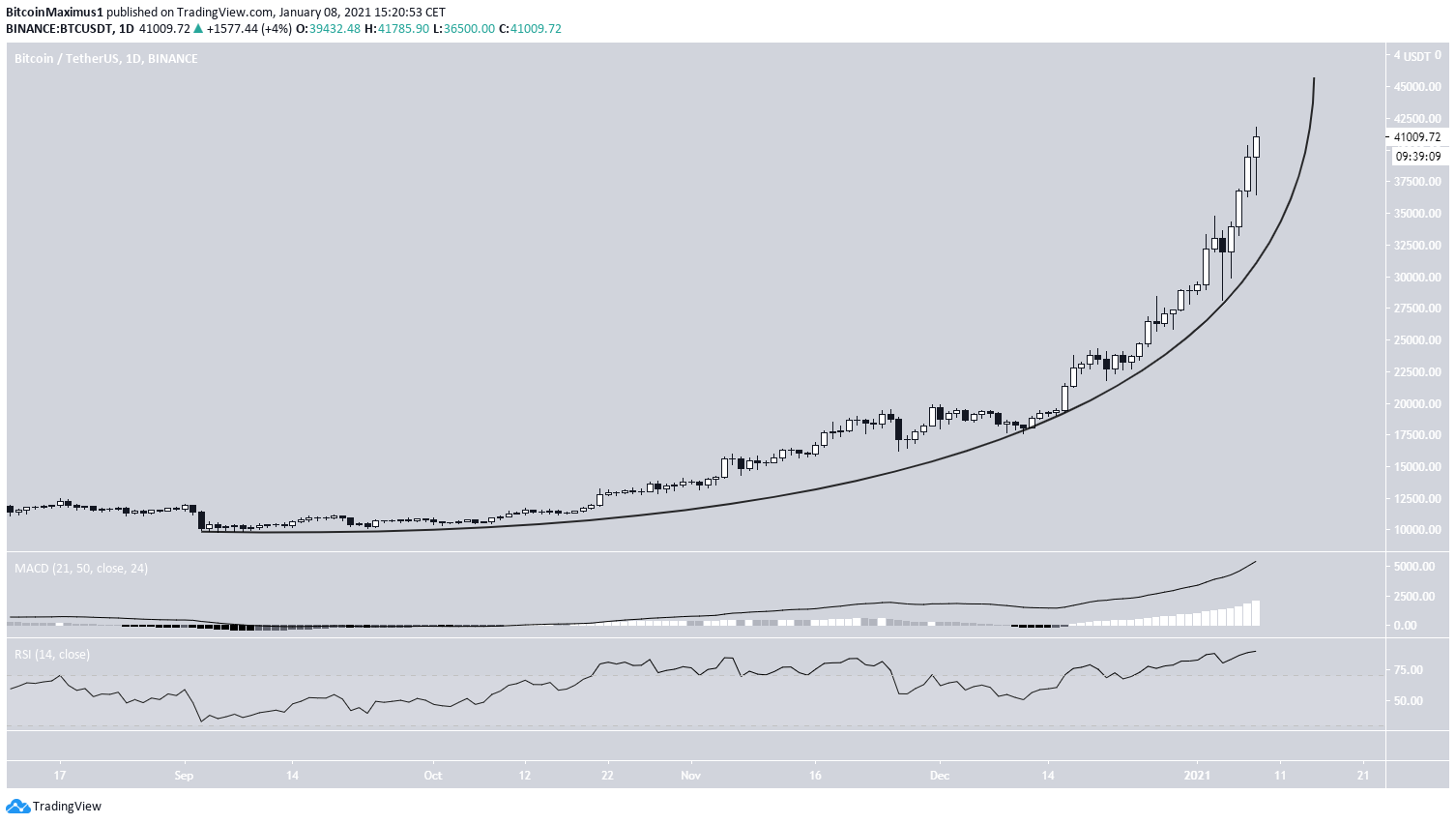
Bitcoin has been increasing rapidly since the beginning of Sept. moving upwards in a parabolic line. Until now, it has reached a high of $41,785, which is the current all-time high price. This marks a more than 400% increase from the Sept lows of $9850. While the rally is definitely overextended, as is visible by the overbought levels in the RSI, there is no definite sign of weakness yet that would confirm the move is coming to an end. Nevertheless, a parabolic rate of increase is unsustainable in the long-run, and the wave count suggest a high between $42,000-$46,000 before a significant correction.
While short-term trading can be stressful, due to the high volatility and numerous movements such as fakeouts that are near impossible to predict, BeInCrypto has created a telegram group to provide daily discussions about recent price movements as well as educational content intended to help traders of every skill level.
Click here to join the FREE telegram group
Sponsored
Important Highs and Low
Highs
Lows
$1177.19 – November 30, 2013
$163.88 – January 14, 2015
$783.93 – June 18, 2016
$198.38 – August 25, 2015
$19,764.21 – December 17, 2017
$3148.33 – December 15, 2018
$13,831.25 – June 26, 2019
$3850 – March 13, 2020
Previous Market Cycle Comparison
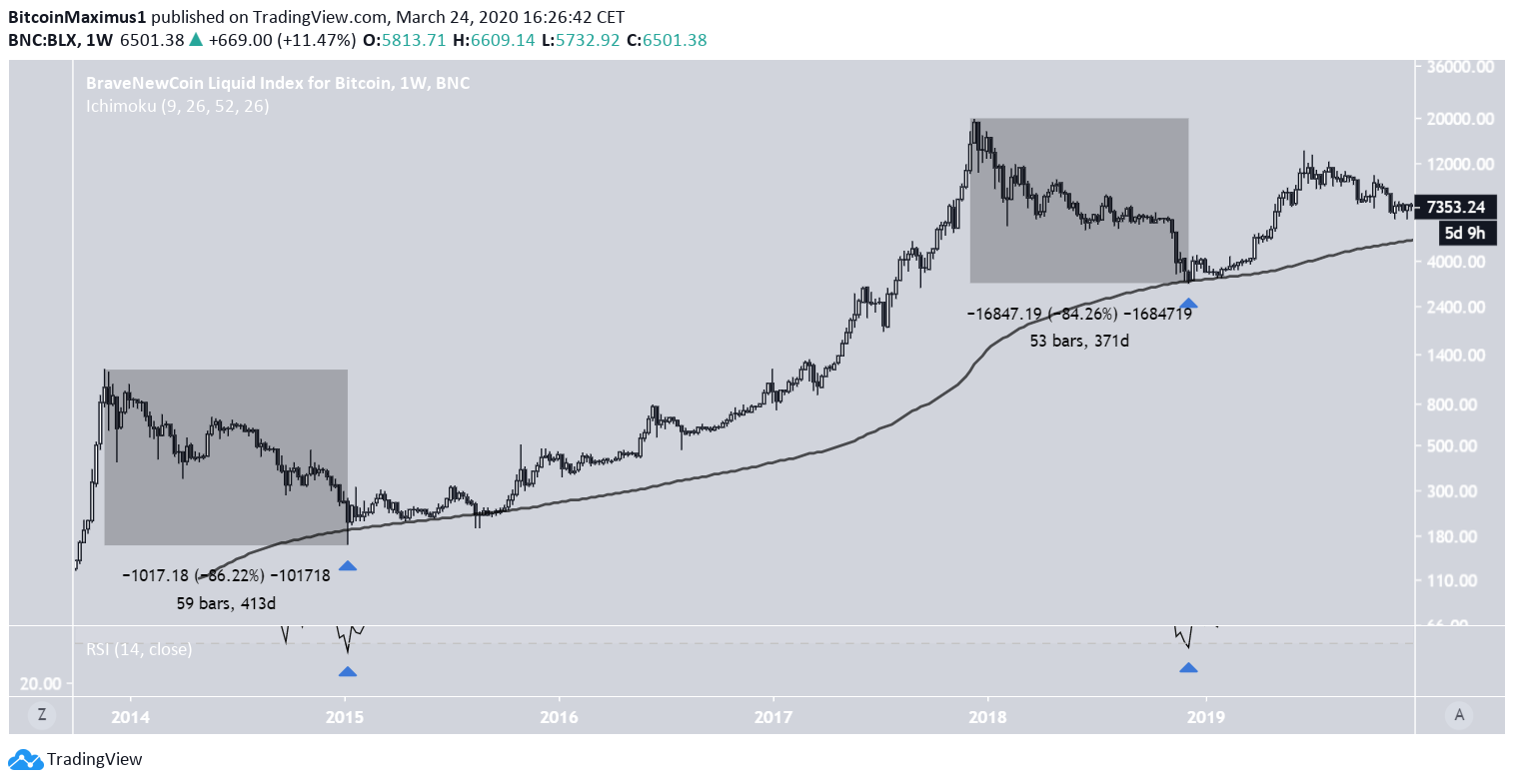
In order to make long-term predictions, we need to make a comparison between the current market cycle and previous ones. There are definite similarities between the downward movement following the $1,177.19 high on November 30, 2013, and the follow-up high of $19,764 high on December 17, 2017. More specifically, the amount of time it took for the price to reach a low and the magnitude of decrease from the high to the low are eerily similar. The price reached a low of $163.88 on January 14, 2015. This occurred 410 days after the previous high and marked a total decrease of 86%. After the December 2017 high, the price reached a low of $3,148.3 on December 15, 2018. This occurred 371 days after the previous high and marked a decrease of 84%. Using technical indicators, we can see even more similarities between the two moves:
January 13, 2014, and December 15, 2018 lows are the only dates in which the weekly RSI fell below 30.
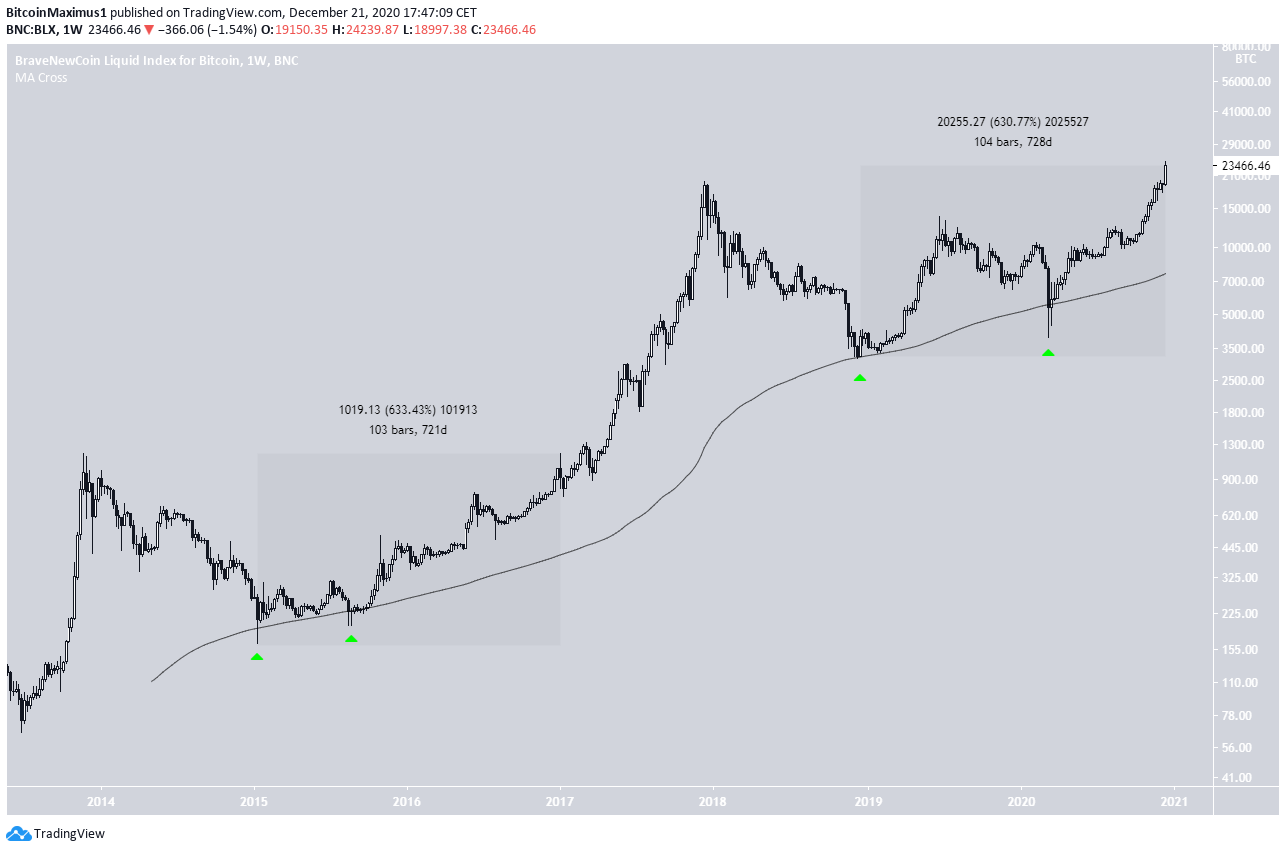
Finally, both these lows caused the price to touch the 200-week moving average (MA). Therefore, it would make sense if these two lows marked similar points in their respective market cycles.
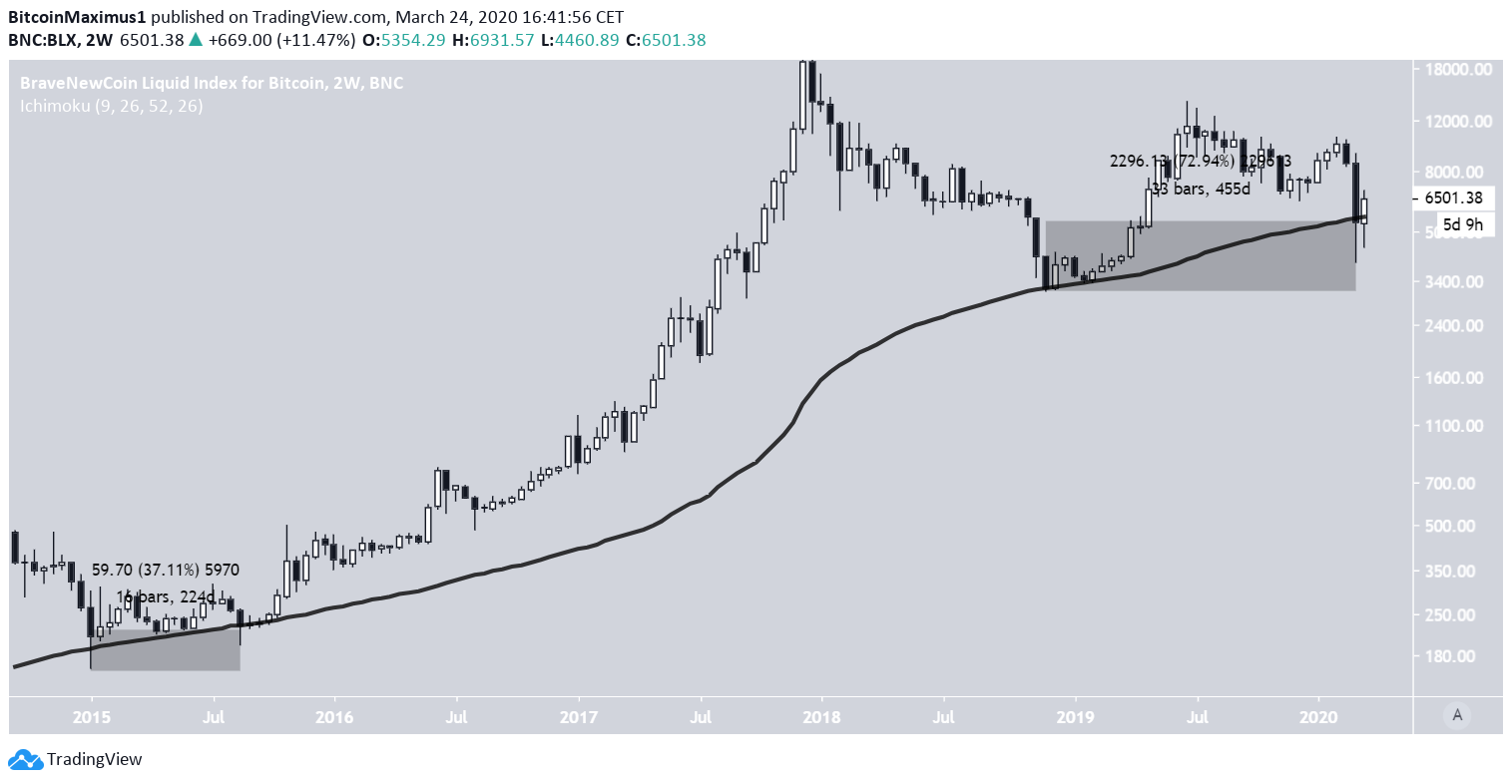
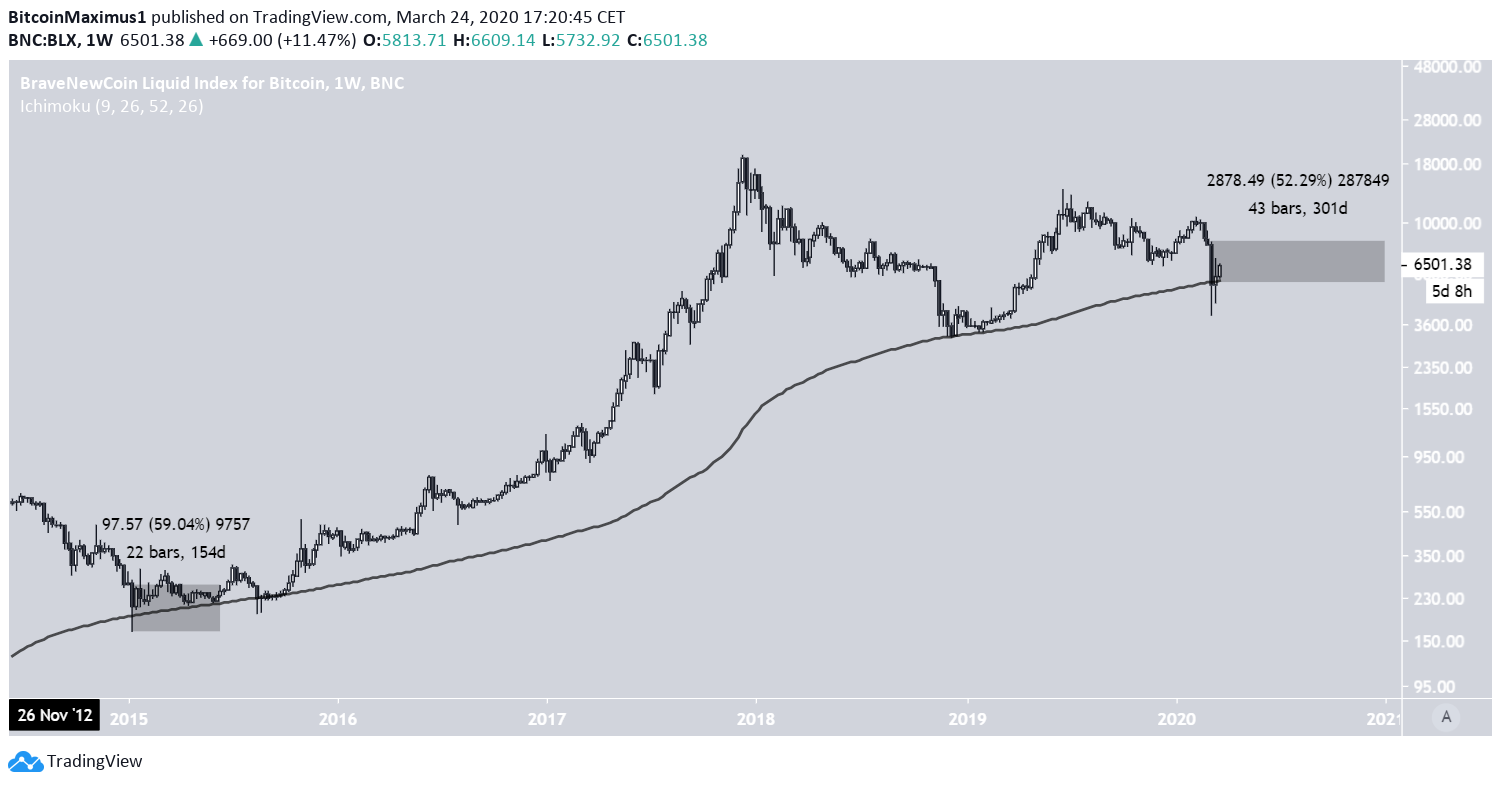
But, the movement since the low has been nothing alike. After the December 2018 bottom, the price increased by 337% in 196 days. In the 2015 movement, it took the price more than 500 days in order to increase by the same amount. Another interesting similarity that can be used to make a prediction comes from the retest of the same 200-week MA, which occurred in August 2015 and March 2020. Both times, a long lower-wick was created below the MA before the price proceeded to reach a close above it. Therefore, it is possible that these two lows mark similar points in the market cycle. In 2015, the touch of the MA occurred after 224 days and the price close was 37% higher than the original bottom. This amounts to a daily rate of increase of 0.163%. In 2019, the touch occurred after 455 days and the price was 72% higher than the previous bottom. This amounts to a daily rate of increase of 0.158%. Both rates are quite similar, so the possibility arises that the March 2020 bottom and August 2015 low represent similar points in the market cycle. However, the movement in 2020 is unfolding at a much slower rate, which makes sense, since as the asset matures we would not expect similar volatile swings in rapid fashion to continue taking place. Furthermore, this does not invalidate the extremely similar bottoms of January 2015 and December 2018 but suggests that the movement decelerated afterward. However, the price eventually returned to the mean, which in this case is the 200-week MA. The actual difference in time periods is 0.49 (224 days/455 days), but for the sake of simplicity we will round it up to 0.5. Both movements had the same rate of daily increase.
\\Presenting both movements in a lower time-frame, there are definitely some similarities, even if the movements are not identical. However, in the 2015 movement, while the bearish engulfing candlestick caused the price to decrease way below the previous support area, the price was quick in reclaiming it. The price has to do the same this time around with the support which has now turned to resistance at $6,800 in order to continue with the fractal. If not, the price could decrease further and make a new low. We will discuss this possibility in the ‘Alternate Prediction’ section below.
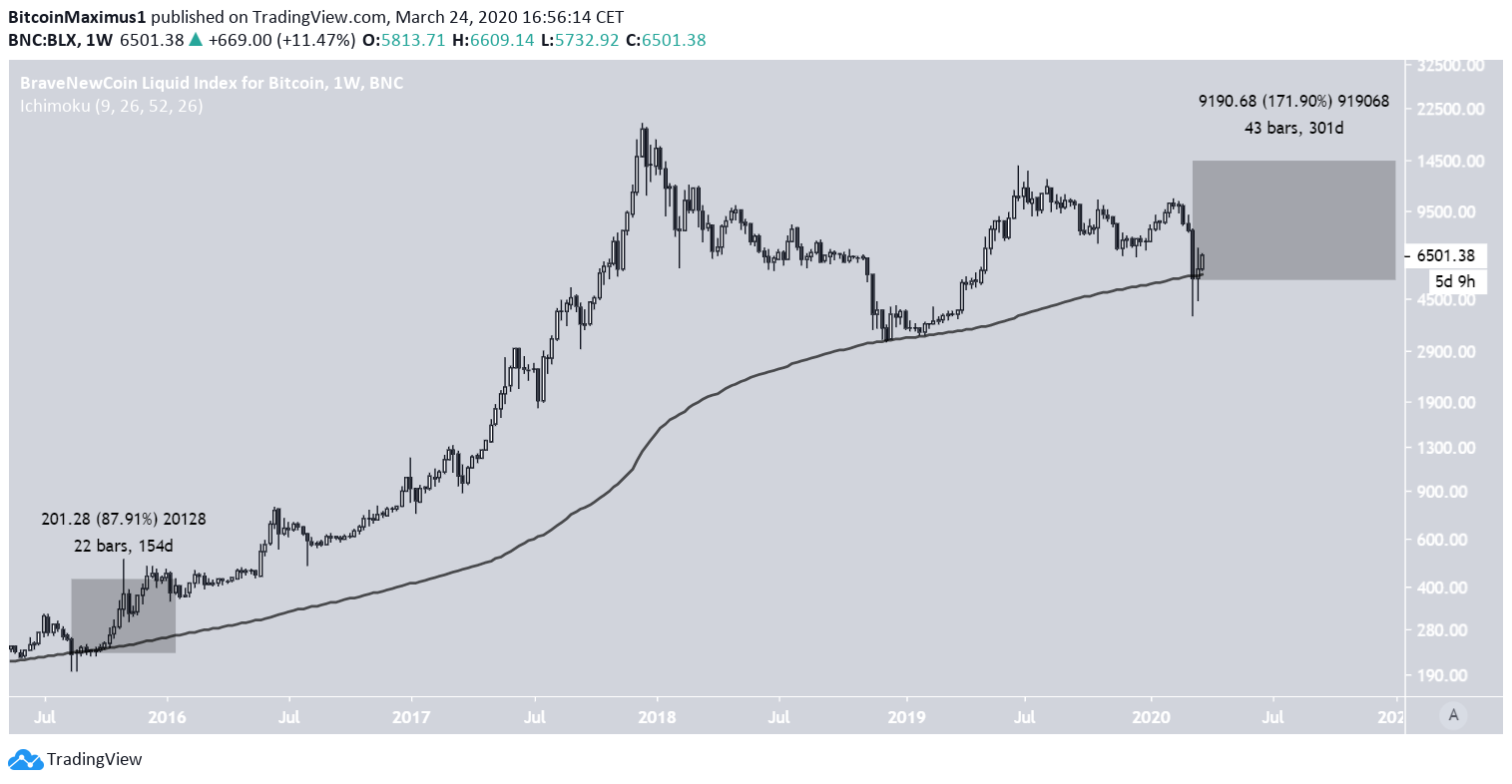
There are 301 days until December 31, 2020. Using the 0.5-time period rate, we will find the price 151 days after the August 15, 2015 bottom, which shows an increase of 88 percent from the bottom, marking a daily rate increase of 0.56 percent. Using the same daily rate of increase for 301 days, we get a price of $14,500 for December 2020.
We can use the same method to make a prediction for the price at the end of 2021. Doing so, we get a price of $32,600 on December 31, 2021.
Bitcoin Chart By TradingView
2020 Halving
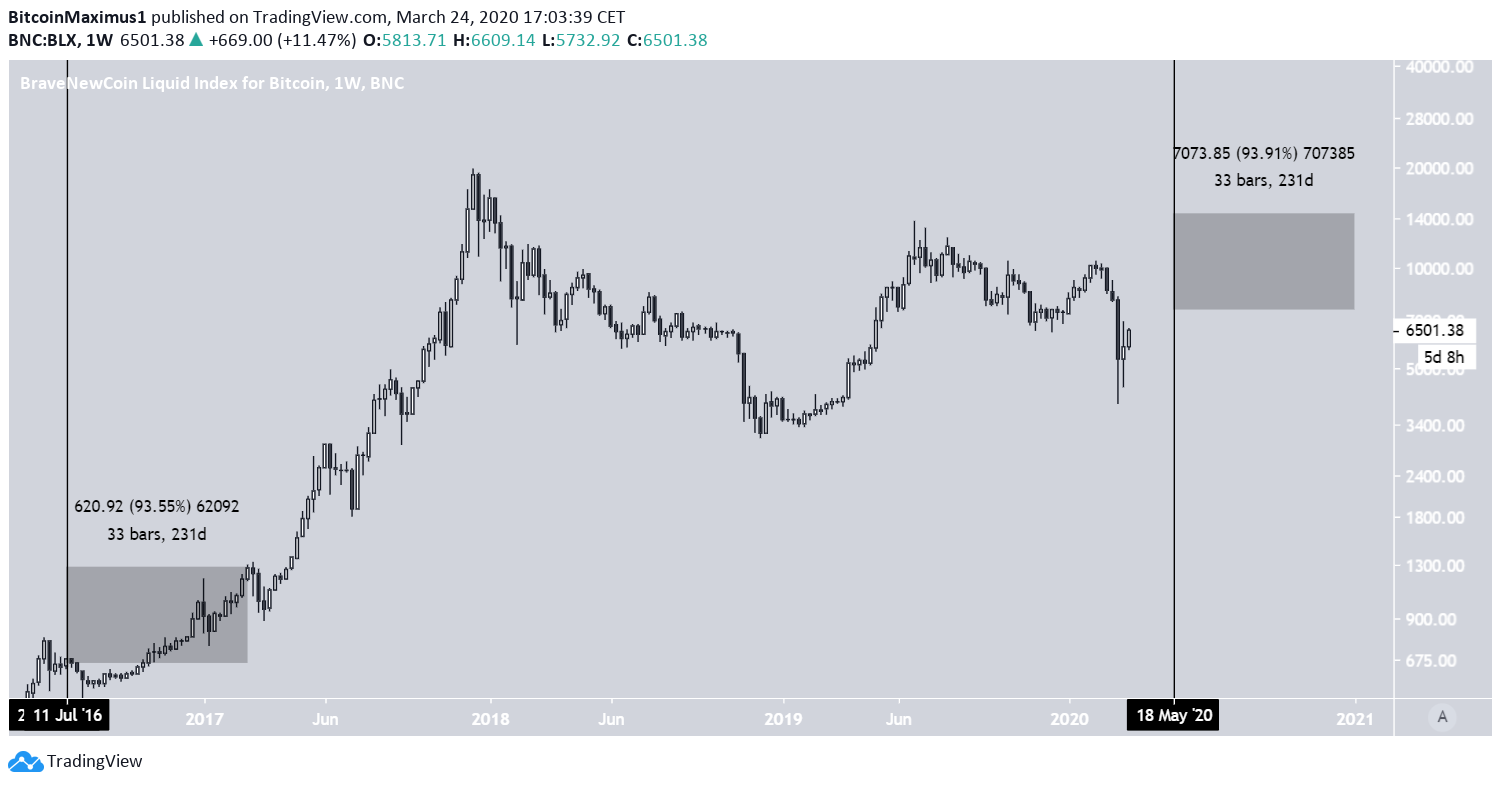
Another less-complicated but less-accurate method to make a prediction would be to look at the rate of increase after the halvings, since the third one is projected to occur in May 2020. After the second halving, the BTC price increased by 93% in 231 days, which is the number of days from the projected date of the third halving until the last day of 2020. The issue with this method is that we do not know what the price will be on the halving date. However, considering the 93% increase, a price of $7,500 on halving would give a $14,800 price at the end of the year, fitting with our previous prediction.
Alternate Prediction
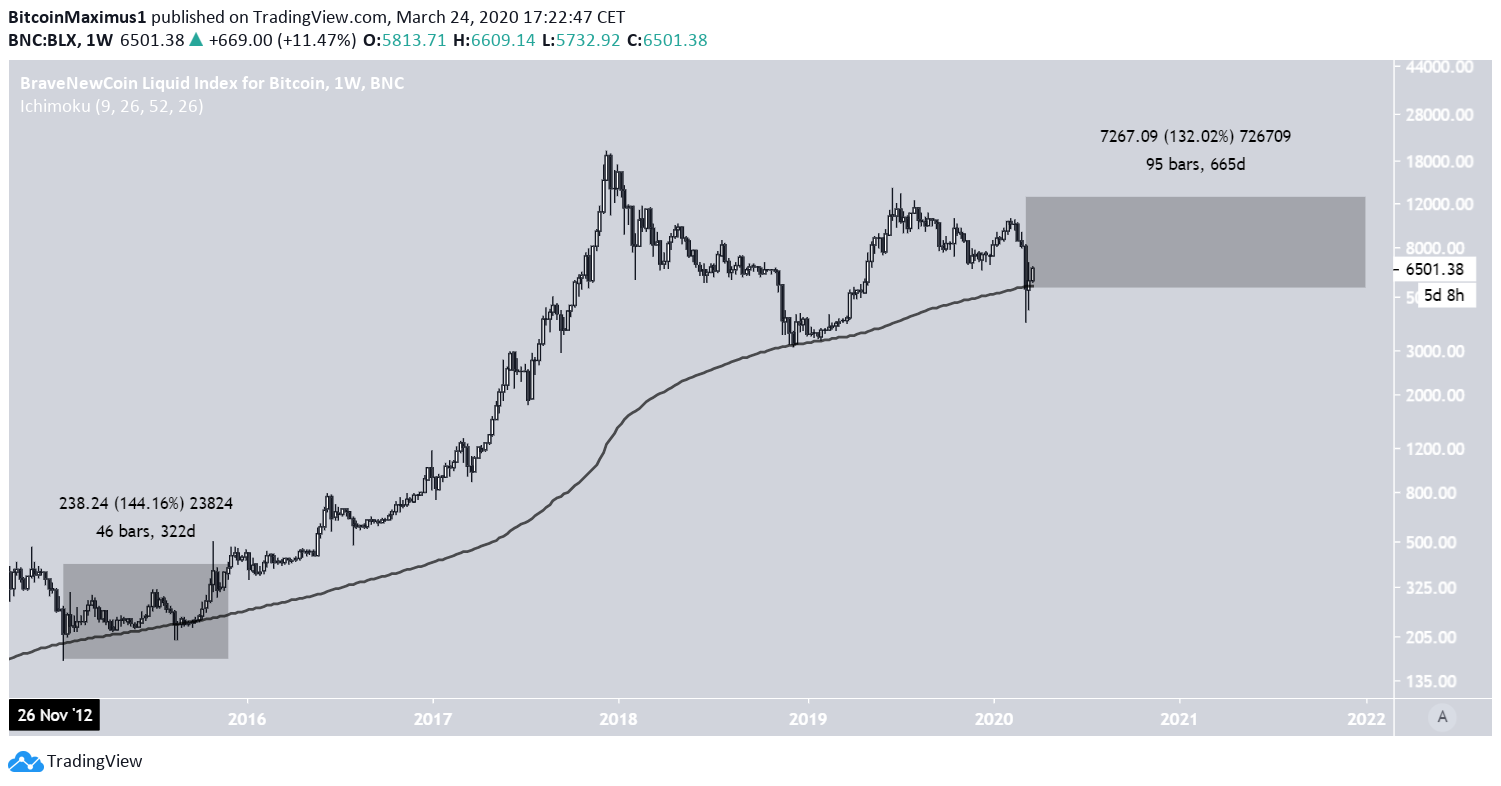
A more bearish prediction suggests that the March 13, 2020, low coincides with that in January 2015, instead of that in August 2015. This is not supported by the RSI but is supported by the fact that there was a very long lower-wick that decreased below the MA. Furthermore, the price movement does not completely support this comparison, since the December 2018 bottom is lower than the current one. This prediction makes the assumption that both the movement and the rate of increase are twice as low in 2020. In this case, the price has yet to begin a bullish trend, since it will make a type of double-bottom, similar to what the price did in August 2015.
We can use the same method we used previously to arrive at the December 2020 prediction. We will still measure the price 151 days after the low in 2015 since the rate of movement is twice slower. However, the total increase will be slightly smaller in 2020, and the bottom in 2015 will be measured from January instead of August. Doing this gives us a price of $8,400 for December 31, 2020.
Using the exact same method with 322 days instead of 154 gives us a price of $12,600 on December 31, 2021.
Bitcoin Price Prediction 2020
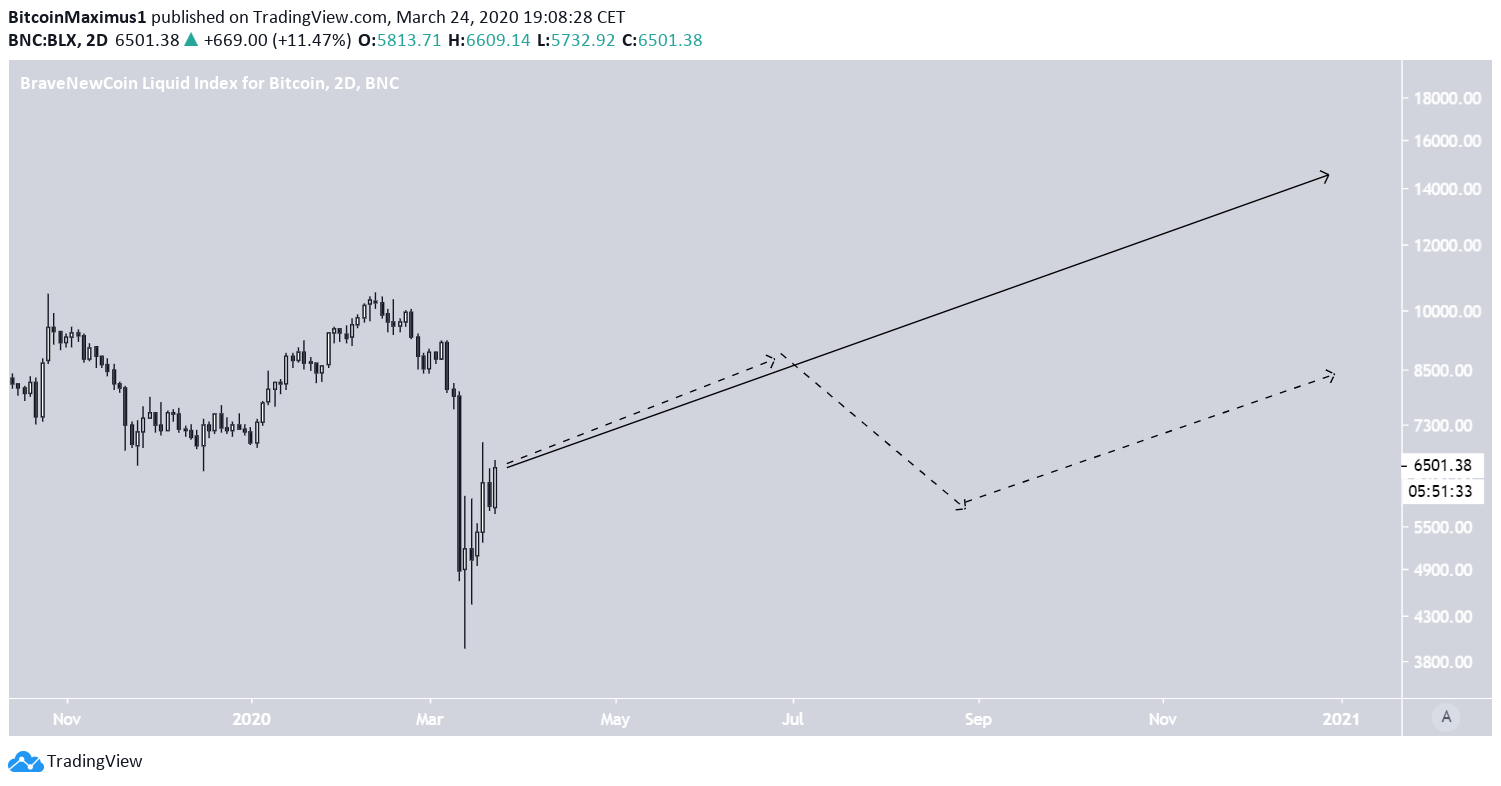
For December 31, 2020, we arrived at a different price with each method, $14,500 and $8,400 respectively. The principal method suggests the price will continue to increase inside a gradual upward trend and eventually reach $14,500. The alternate method (dashed), has a similar movement in the beginning, but the price is expected to decrease initially, before bouncing and reaching $8,400.
Bitcoin Chart By
Bitcoin Price Prediction 2021
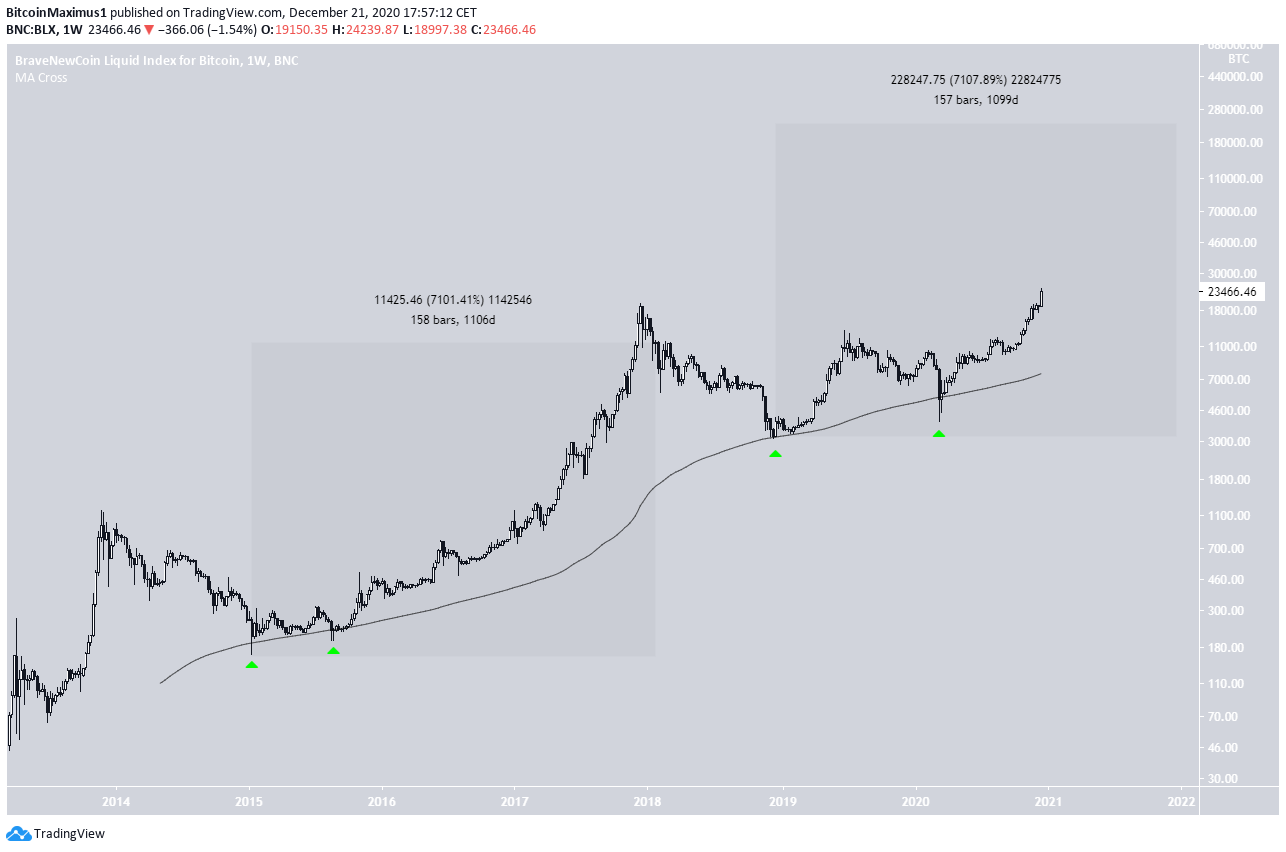
The movement in 2020 has made us adjust our predictions slightly. The reason for this is the faster than expected rate of increase after the second touch of the 200-week MA (shown in black below). Therefore, the fact that the movement in between the two touches of the MA was much slower in 2018 than 2015, that was not a sign that the upward trend in 2018 is slower, but only a sign that it is lagging. This was evident in the identical times it took both movements to reach an all-time high. After the first touch of the MA on January 2015, it took BTC 721 days to reach a new all-time high, which was an increase of 633%. After the first touch of the MA on March 2018, it took BTC 728 day to reach a new all-time high, which was an increase of 630%. Therefore, we can assume that the movement after the March 2018 low coincides with that after the January 2015 low at the same rate of increase and period of time, rather than being twice slower as we previously hypothesized.
If the same rate of increase holds, BTC would reach a high of $230,000 on Dec. 31, 2021. While this high is considerably above the current price, which would require BTC to increase rapidly throughout the year, it is made with the assumption that the same rate of increase will hold the same way it did in 2015.
Five-Year Bitcoin Price Prediction
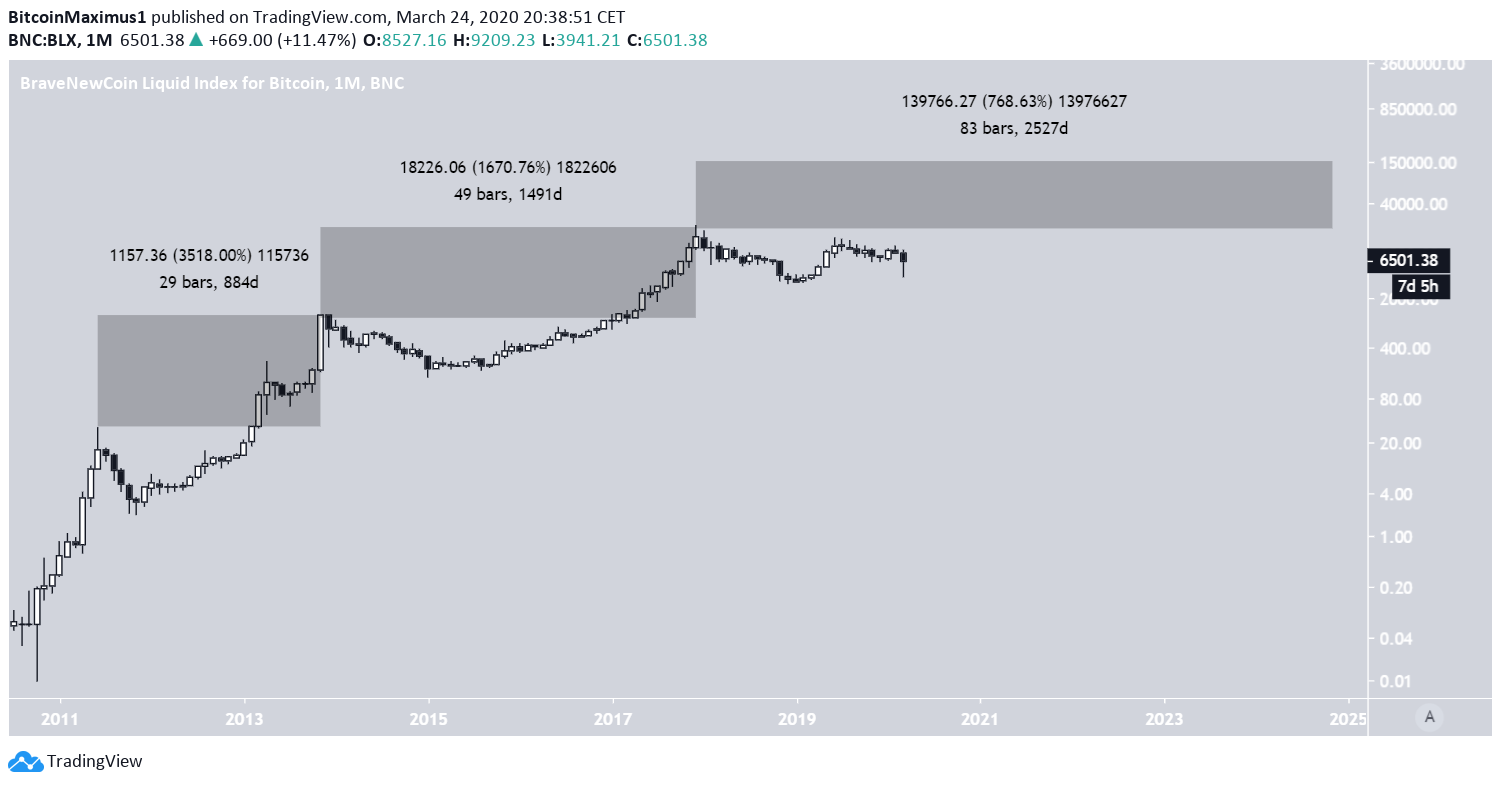
In order to make a prediction for the Bitcoin price five years in advance, we will compare the rate of increase and time periods between each high in the existing market cycles. There have been three main upward moves from Bitcoin’s inception until now. The time it took for the price to move from the first to the second high was 884 days, and the price increased by 3,514%. The movement from the second to the third high took 1,491 days, and the price increased by 1,641%. Therefore, the second move was 1.68 times slower and 0.46 times as large. Using these ratios for predicting the possible next move, the high will be reached 2,514 days after that in December 2017 and will be 766% higher. Using this method, we arrive at a high of $160,000 in December 2024.
Date
Main Prediction
Alternate Prediction
December 31 2020
$14,500
$8400
December 31 2021
$230,000
$12,600
December 31 2024
$160,000
Disclaimer: This article is not trading advice and should not be construed as such. Always consult a trained financial professional before investing in cryptocurrencies, as the market is particularly volatile. Do you think our predictions will be accurate? What are your thoughts on the methods used to reach our conclusions? Let us know in the comments below
San Francisco-based fintech firm Ripple has unveiled a creator fund to foster non-fungible token (NFT) development on its own blockchain.
On Sept. 29, Ripple announced that it had launched a $250 million creator fund that will research new use cases for NFTs on the XRP Ledger (XRPL). Ripple stated that its new fund will provide targeted support for creators, brands, and marketplaces to develop NFTs on the XRPL.
Ripple asserts the future will be tokenized and it doesn’t intend on missing out on the NFT frenzy that has dominated crypto news in 2021. It has the lofty ambition of becoming the “premier platform” for NFT creation, minting, and management.
Ripple-powered NFTs
The fund was announced as part of Ripple’s XRPL developer summit on Wednesday. The company stated that many creators are still hesitant to engage with NFTs due to technical concerns or for fear that their creations will not be popular.
It also took an indirect swipe at Ethereum, the current standard for NFT creation, stating that high transaction fees and environmental impact concerns are also a hindrance.
“Ripple aims to alleviate these challenges by providing the financial, creative and technical support needed for creators to engage and eventually deliver new NFT use cases.”
The company will be partnering with NFT marketplaces mintNFT and Mintable, which raised $13 million in July, and will integrate the XRPL, it added. Chicago-based global creative agency VSA Partners has also joined the initiative to help its creator and brand clients create and sell their NFTs.
Ripple claims that XRP Ledger’s built-in decentralized exchange has enabled the issuance or trading of more than 5,400 different tokens since its inception. It also claims to be up to 120,000 times “more efficient than leading proof-of-work blockchains.”
Until now, Ripple has been notably absent from the NFT scene which is dominated by Ethereum. NFT support was originally enabled on XRPL back in May when Ripple decided to combat high gas fees.
XRP price outlook
Ripple’s native token, XRP, has gained 4.2% on the day according to CoinGecko. At the time of press, XRP was trading just below a dollar at $0.961.
The cross-border payments token has been hit hard over the past fortnight, losing 14%. It’s still 72% down from its January 2018 all-time high of $3.40. This year, XRP peaked at $1.84 in April while most cryptocurrencies in the market cap top-ten registered new all-time highs.
Portfolio manager for TWC Group sees more crypto-lending inquiries, which he says is good for the future of bond funds.
At the Morningstar Investment Conference, Bryan Whalen of TWC Group remarked on the rise of inquiries from crypto investors. Whalen said digital asset investors increasingly ask large institutions for loans against their digital assets. Moreover, he said this happens even in the world of bond investments.
Whalen oversees about $225 billion as managing director of TWC’s fixed income group. “The market is starting to knock on the doors of big institutions, even in the bond world,” he said. “What I’ve found has crept our way is incoming inquiries about the question of lending against crypto.”
However the director says TCW does not service such requests. Though he suggested others such as hedge funds and alternative asset managers might.
For example, Fidelity Investments partnered with BlockFi to allow institutional clients the ability to pledge Bitcoin against cash loans. Robin Foley, the chief investment officer of bonds for Fidelity, said they’re looking to the future of the markets. “For us the role of crypto is really a cross-market, cross-company conversation,” Foley said. “We are looking to the future as the market evolves.”
Despite the high profile partnership with Fidelity, BlockFi faced scrutiny from various states towards its crypto lending program.
Crypto Lending Under Scrutiny
The crypto industry faces a slew of new scrutiny as regulators target crypto lending and interest programs. As mentioned above, BlockFi received a series of negative reactions from state regulators over its program.
Today, September 23rd, 2021 Kentucky lawmakers zeroed in on yet another crypto firm. The state prohibited the crypto lender Celsius from offering accounts within the state. Lawmakers cite the company offering “unregistered securities” to clients and a lack of post-deposit transparency.
In addition, Coinbase received major backlash from the U.S. Securities and Exchange Commission over its new crypto lending program. The company planned its new product, Lend, as a way for investors to make money off of their invested crypto. Nonetheless, the SEC threatened a lawsuit and inquired about names on the waitlist for the product.
















 went from $1.50 -> $20.00 in the Year 2020 … absolute face melter. Top performing asset in the top 20 cryptocurrencies.















 Site Title